


There are many reasons why people from all over the world visit Korea. It could be for sightseeing, language study, professional work, or to stay with family. However, while there are some countries that you can enter without a visa, many others require a purpose-specific visa to stay legally. In this article, we’ll outline the different types of Korean visas and outline the basic requirements, length of stay, and extension options for each. This may seem like a complicated system, but it’s surprisingly easy to get to the right answer once you’re clear on your purpose.
Tourist visas (visa on arrival and C-3)
Visa-free entry (visa waiver)
Among the types of Korean visas, the Korean government has reciprocal agreements with certain countries that allow travellers to visit Korea without a visa for a certain period of time. For example, travellers from the United States, Canada, Australia, and some European countries can enter Korea without a visa for up to 90 days (subject to K-ETA pre-approval). During this period, pure tourism, visiting relatives, and short-term commercial activities are allowed, but wage-earning employment or study is not permitted.
Even if you can enter the country without a visa, you must check the maximum number of days for each nationality as overstaying is illegal. Also, more and more nationalities are required to apply for a K-ETA (Electronic Travel Authorisation) in advance, so check the latest information before travelling.
C-3 Short-term tourist visa
If you are from a country that does not have visa-free access to Korea, you should apply for a C-3 (Short-term General) visa. This visa allows you to stay for 90 days or less and is for tourism, visiting, or participating in short-term events. It can be obtained by submitting documents (application form, passport, financial proof, etc.) to an embassy or consulate. Extensions of stay are generally not possible, but may be considered by the immigration office if there are special reasons.
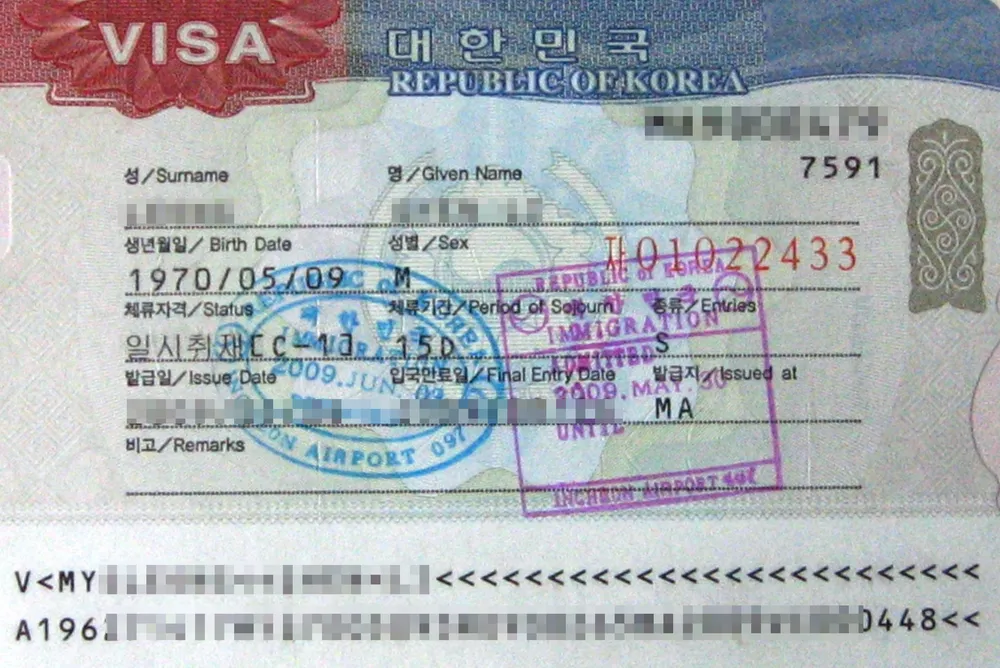
Student visas (D-2, D-4)
D-2 (Degree Programme)
The D-2 visa is for foreigners who have been formally admitted to a Korean university or graduate school to pursue a bachelor’s, master’s, or doctoral programme. You must apply to the embassy with a letter of acceptance, proof of financial ability (to cover tuition and living expenses), and proof of education (graduation certificate). Once you enter Korea, you will be required to pay national health insurance after six months. D-2 visas are issued and extended in one- or two-year increments, depending on the length of your studies, and expire at the end of your studies.
It is important to maintain your academic record, so if you drop out of school or have too low of an attendance rate, your visa may be cancelled. If you work part-time, you will also need to obtain a ‘part-time work permit’ from the immigration office. Your school’s international exchange office can provide you with more information.
D-4 (Language Training)
Apply for a D-4 visa to study Korean language, vocational training, or an academy course that is not a degree. The duration is usually between six months and one year, and the required documents include an acceptance letter, financial proof, and purpose document. If you stay longer than six months, you will be covered by health insurance, and you must follow the attendance rules to keep your visa.
Work visas (E-1 to E-7)
E-2 (Native speaker), E-7 (Professional)
To work in South Korea, you must have the appropriate work visa. The E-2 visa is the most common type of Korean visa for native speakers of foreign languages to work as teachers in hagwons and schools. When applying, you will need to provide a criminal record check, proof of your bachelor’s degree, and an employment contract. If the school issues a letter of invitation, it is easy to apply to the embassy.
On the other hand, E-7 is a visa for professionals (technicians, engineers, designers, chefs, etc.) to work in Korean companies. There are specific education and work experience requirements for each type of job, so you need to make sure you meet the requirements of your employment contract.
E-1 to E-5
There are a number of other specific visas, including E-1 (Professor), E-3 (Research), E-4 (Technical Instructor), and E-5 (Specialist). These visas are designed for specific occupations, so check the immigration website to see which category your speciality falls under. The application process is lengthy and involves a lot of paperwork, so working with a sponsoring company or university is essential.
Other major visas: F series
F-2 (resident), F-4 (alien alien), F-6 (marriage)
If you’re looking to stay in the country for a long period of time, you may want to consider an F series visa. For example, F-2 (resident) is a long-term visa that can be obtained with certain qualifications (married immigrants, certain experience, points system, etc.). F-4 (Overseas Korean) is for foreign nationals of Korean ancestry and allows them to work and do business freely. The F-6 (marriage immigrant) visa is for those who marry a Korean spouse and settle in Korea. These visas have the advantage of a long period of stay and relatively free employment.
Visa extensions and changes: A quick overview
All visas have an expiry date, before which you must apply for an extension to stay in the country legally (this topic will be covered in more detail in the next article). You can usually apply for an extension up to four months before the expiry date, make an appointment online through the immigration office’s website (Hi-Korea), or even apply online for some visas.
A change of visa type (e.g., a D-2 student switching to an E-7 work visa after graduation) is subject to a separate examination. Application documents may include the relevance of your major to your job, employment contracts, etc. The change of status process can be tricky, so be prepared.
Types of Korean Visas: Choosing the Right Visa for Your Purpose is the Start of a Smooth Stay
If you want to visit Korea for short-term tourism, you can get away with a visa-free or C-3 visa, but if you want to study, work, or stay longer, you’ll need the right visa for each purpose. There are different types of visas, such as E-type work visas, D-type study visas, and F-type long-term residence visas, so you’ll need to clarify your situation (length of stay, activities, and availability of sponsorship) to find the right visa for you.
It’s important to note that each visa has different documentation requirements, conditions, and rules that you must follow during your stay. For example, study visas do not allow for any purpose other than study (such as full-time employment), work visas can get you in trouble if you work beyond the scope of your authorised occupation, and you should be aware that if you miss the extension process before your visa expires, you will become an illegal immigrant.
This overview of Korean visa types is only a high-level guide, and you should check with your embassy, immigration office, or employer for details. Depending on your nationality, background, and level of documentation, the requirements may vary slightly. Having the right visa can make your life in Korea much easier and open up a wide range of opportunities, so take the time to prepare.
A Visa and a Residence Status Are Not the Same Thing
Most confusion about the Korean system starts here. A visa authorizes entry; a residence status governs what you may do once you are inside. They share the same codes but are separate things.
- The visa is used once, at entry. Clear immigration and its job is done.
- What governs everything afterwards is your residence status and period of stay — the status and expiry printed on your residence card.
- So “I have a three-year visa” is usually imprecise. A visa’s validity and the period of stay granted per entry are different numbers, and an extension lengthens the second.
The codes follow a pattern too: the letter is the broad category, the number the specific type.
| Letter | Category | Examples |
|---|---|---|
| A | Diplomatic and official | A-1 diplomat, A-3 under agreement |
| B | Entry without a visa | B-1 visa exemption, B-2 tourist transit |
| C | Short-term | C-3 short-term visit, C-4 short-term employment |
| D | Study, training, investment, posting | D-2 study, D-4 training, D-10 job seeking |
| E | Employment | E-2 language instruction, E-7 specific activity, E-9 non-professional |
| F | Residence, family, overseas Koreans | F-2 residence, F-4 overseas Korean, F-5 permanent, F-6 marriage |
| H | Working holiday, visiting employment | H-1 working holiday, H-2 visiting employment |
What matters in practice is that the sub-number changes what you may do even within the same letter. D-4 itself splits between language training and other training, with different permitted activities. Check the exact code on your residence card and research against that code, not the letter alone.
Single, Multiple, and Re-entry
If you plan to leave and come back, this is the section to read. What matters is whether your visa is single or multiple entry, and whether you need a re-entry permit.
- A single-entry visa is consumed on entry. Returning after departure requires separate arrangements.
- A multiple-entry visa allows repeated entries within its validity.
- Long-term residents who have completed alien registration are generally exempt from the re-entry permit for absences within a defined period. But exceeding that period can cost you your residence status.
- If you will be away longer than the exemption allows, obtain the re-entry permit before departure — it cannot be arranged once you have left.
The classic accident is a long trip home during which the exemption period quietly expires. When an extended stay abroad comes up, check your own status’s exemption period at Hi Korea or on 1345 before you fly, and count the days.
Status Change, Activity Outside Status, Workplace Change
When your current status does not permit what you want to do, there are three different procedures — and they are not interchangeable.
| Procedure | When | Effect |
|---|---|---|
| Change of residence status | Your main activity changes (study to work) | The status itself changes |
| Permission for activity outside status | Main activity continues, something else is added (a student working part-time) | You keep your status with an additional permitted activity |
| Change or addition of workplace | The employer changes within the same status | Some cases need prior permission, others a report afterwards |
All three work the same way: get permission first, then start. Reversing that order makes it activity outside status and counts against you in later reviews. If you cannot tell which procedure applies, asking 1345 before you begin is the fastest route.
K-Name Studio: Create your perfect Korean name based on your personality and style.
What’s My K-Beauty Personal Color?
WeBring Service : Provides personalized services to foreigners living in Korea
Exclusive offer: Introducing foreign car rental in Korea, WeBring-SoCar
- Korean Student Visa Guide: D-2 & D-4 Visa Application, Requirements, and Living in Korea
- Long-term stay in Korea: 4 procedures and reporting obligations
- Korea Foreigner Re-entry Permit: Your Essential Checklist to Avoid Visa Issues & Master 3 Key Dates
- Work Visa Change: Key Considerations for Foreign Nationals in Korea
Last updated: 22 September 2026
Immigration rules and guidelines change often. This article summarises information that was publicly available when it was written and is not legal advice for your individual case. Confirm the current requirements with HiKorea (1345) or your local immigration office before you apply.
WeBring operates its own visa application and extension service. The following is a promotion for that service.
Don't let your visa expire
Check your remaining stay and extension deadline in 30 seconds with the WeBring visa calculator. Need help with the paperwork? Our experts speak your language.