


One of the most important preparations for foreigners entering South Korea is the passport and visa requirements associated with the entry process. These documents are mandatory items that you must have in place before stepping foot on South Korean soil. Passports and visas have different requirements depending on your purpose of travel, length of stay, and nationality. The information below will help you learn more about the process of preparing your passport and visa to enter South Korea. This is part 24 of our Complete Guide to Living in South Korea for foreigner series.
Prepare your passport
Your passport is the most important document that proves your identity when traveling internationally. All international visitors must have a valid passport, and it must be valid for at least six months from the date of entry, which means it must remain valid for the duration of your planned stay and until you return home.

The process for getting a passport varies from country to country, and you can usually apply through your country’s foreign ministry or equivalent organization. To get a passport, you’ll need documents such as ID and photos, and some countries require an interview process. The length of time it takes to get a passport depends on the country you’re applying to and the process, so you’ll need to take this into account when planning your trip.
South Korea Visa Information
A visa is permission to enter, stay in, or travel through a specific country. Depending on the purpose of your visit to South Korea and the length of your stay, you might need a visa. Below is an example image of a South Korean visa.
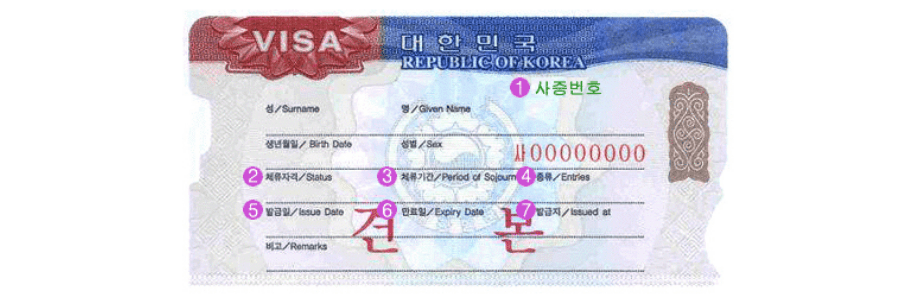
- 2) Status of Residence: You can see the purpose of entering Korea (Married immigrants: Status of Residence F-6).
- The date in the immigration confirmation is the date you entered Korea. Your period of stay in Korea is calculated from the day after your entry.
- 3) The period of stay depends on your status of residence, and you must apply for alien registration and extend your stay before your period of stay expires (within 90 days from the date of entry) (whether you can extend your stay depends on your status of residence and the reason for the extension).
- 6) Expiration date, located just below the period of stay, indicates the validity of the visa.
South Korea Visa Waiver Countries and K-ETA
South Korea offers visa-free visits for short-term stays to citizens of countries with which it has visa-free agreements. This applies to stays of at least 30 days to 180 days, including tourism, short-term business, and family visits. You can find a list of countries with visa waiver benefits on the following website.
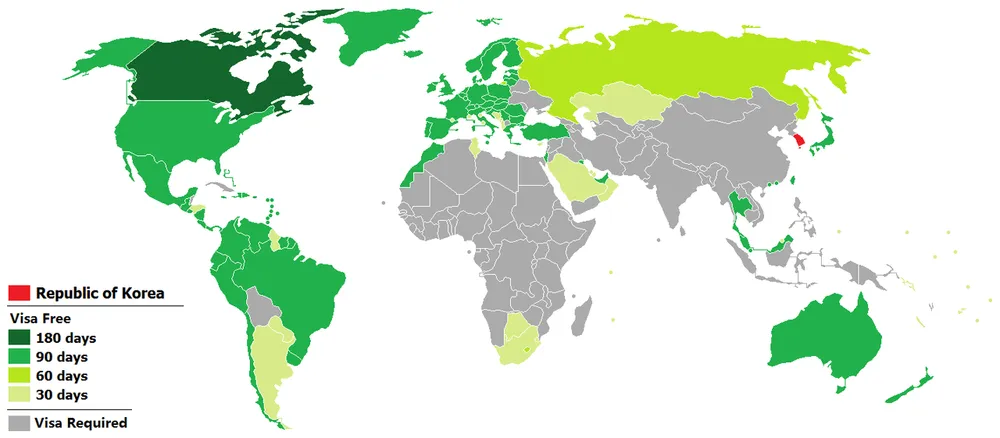
As you can see in the image above, South Korea allows citizens of countries with visa-free agreements to enter South Korea without applying for a visa. Some countries range from 6 months (180 days) to 30 days in the case of Canada. However, with the implementation of the Electronic Travel Authorization (K-ETA) system, there are some countries that can enter Korea after applying for a K-ETA.
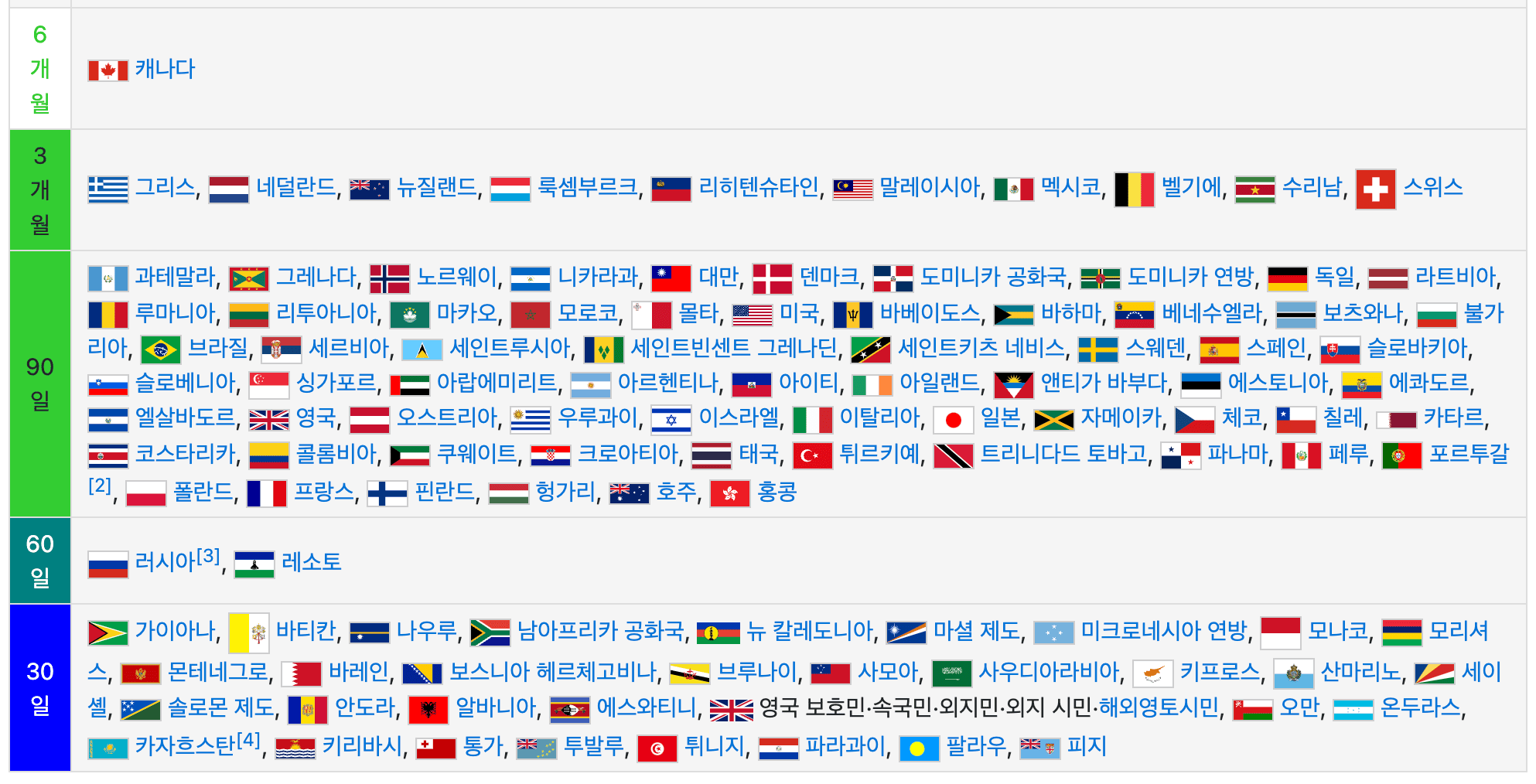
Full list of visa-free agreement countries you can enter after applying for K-ETA
| 6Month | Canada |
| 3Month | Greece, Netherlands, New Zealand, Luxembourg, Liechtenstein, Malaysia, Mexico, Belgium, Suriname, Switzerland, Switzerland |
| 90Days | Guatemala, Grenada, Norway, Nicaragua, Taiwan, Denmark, Dominican Republic, Dominican Commonwealth, Germany, Latvia, Romania, Lithuania, Macau, Morocco, Malta, United States, Barbados, Bahamas, Venezuela, Botswana, Bulgaria, Brazil, Serbia, Saint Lucia, Saint Vincent and the Grenadines, Saint Kitts and Nevis, Sweden, Spain, Slovakia, Slovenia, Singapore, United Arab Emirates, Argentina, Haiti, Ireland, Antigua and Barbuda, Estonia, Ecuador, El Salvador, United Kingdom, Austria, Uruguay, Israel, Italy, Japan, Jamaica, Czech Republic, Chile, Qatar, Costa Rica, Colombia, Kuwait, Croatia, Thailand, Turquoise, Trinidad and Tobago, Panama, Peru, Portugal[2], Poland, France, Finland, Hungary, Australia, Hong Kong |
| 60Days | Russia, Lesotho |
| 30Days | Guyana, Vatican, Nauru, South Africa, New Caledonia, Marshall Islands, Federated States of Micronesia, Monaco, Mauritius, Montenegro, Bahrain, Bosnia and Herzegovina, Brunei, Samoa, Saudi Arabia, and Cyprus, San Marino, Seychelles, Solomon Islands, Andorra, Albania, Eswatini, British Protected Persons, British Subjects, Overseas Citizens, Overseas Citizens, Overseas Territories, Oman, Honduras, Kazakhstan, Kiribati, Tonga, Tuvalu, Tunisia, Paraguay, Palau, Fiji |
The 112 countries listed above are visa-free as of February 2024 and can be entered into Korea with a K-ETA application. For example, citizens of many countries, including Latin American countries in green, need to apply 72 hours in advance through K-ETA to enter Korea. The fee is 10,000 won (plus tax) and can be paid with Visa, MasterCard, JCB, and Amex credit cards.
However, for 22 of these 112 countries, you can enter without applying for a K-ETA. This means that you can visit and stay in Korea without applying for a K-ETA.

Japan, Taiwan, Hong Kong, Macau, Singapore, United States, Canada, United Kingdom, France, Germany, Italy, Netherlands, Belgium, Denmark, Norway, Sweden, Finland, Austria, Poland, Spain, Australia, New Zealand
Jeju Island once had a 30-day visa-free entry, but now requires a K-ETA application. Please note this.
South Korea Visa Types and Entering South Korea
For countries other than the 112 countries above, you must apply for a visa that fits your purpose. Also, even for the visa-free countries above, you must apply for a visa that fits your purpose if you need to stay in Korea for an average of 90 days or more. If you need a visa, you must apply for the right type of visa for the purpose of your visit, and South Korea offers a variety of visa types, including tourist (K-ETA, B-2), business (B-1), student (D-2), and work (E-1 through E-7).
Visa applications are typically made through a South Korean embassy or consulate and require an application form, a copy of your passport, a photo, and an application fee. Depending on the purpose of your visit, additional documents may be required, such as an invitation letter, school acceptance letter, or employment contract.
The visa application process can vary depending on the country and your individual circumstances, so it’s important to give yourself plenty of time to prepare before you leave. Visa issuance is typically within a few weeks of receipt of your application, but can take longer in some cases, so be sure to allow for this in your travel plans.
Having your passport and visa ready to enter and stay in South Korea is the first step in ensuring your trip goes smoothly. Make sure you have all the documents you need ahead of time to avoid any disruptions to your travel plans.
- Korea Working Holiday Visa Complete Guide: Application to Jobs & Travel (2026)
- Types of Korean Visas: A Guide to Tourist, Study, Work, and Long-Term Stay Options
- The Complete Guide to Living in Korea for Foreigner
- Fake Visa Website Detection: 10-Second URL Checklist (Foreigners Must Read)
Last updated: 23 September 2026
Immigration rules and guidelines change often. This article summarises information that was publicly available when it was written and is not legal advice for your individual case. Confirm the current requirements with HiKorea (1345) or your local immigration office before you apply.
WeBring operates its own visa application and extension service. The following is a promotion for that service.
Don't let your visa expire
Check your remaining stay and extension deadline in 30 seconds with the WeBring visa calculator. Need help with the paperwork? Our experts speak your language.