

Korean Vegetarian Restaurant Guide: Vegan Korean Food 7-Day Complete Itinerary

The first worry that travelers searching for a Korean vegetarian restaurant face is, “Can I really stay vegan in Korea?” Korean cuisine looks plant-friendly at first glance, thanks to kimchi and the many vegetable side dishes, but once you walk into a restaurant, anchovy broth, salted-shrimp seasoning, and fish-cake toppings make a strict 100% plant-based diet difficult. As interest in vegan lifestyles has grown, Korean vegetarian restaurants and vegan-friendly venues have expanded quickly in Seoul, Busan, and Jeju, so foreign travelers can still enjoy authentic Korean food.
| Korean Menu | Vegan-Friendly? | Watch Out For |
|---|---|---|
| Temple Food (Sachal Eumsik) | Fully vegan possible | Strict temples avoid the 5 alliums (garlic, scallion, chive, wild garlic, onion) |
| Bibimbap | Meat removal possible on request | Check for anchovy in gochujang and egg yolk topping |
| Vegetable Gimbap | Possible | Always ask to remove fish cake, ham, crab stick, and egg |
| Pajeon / Buchujeon | Mostly possible | Check for seafood in the batter and whether eggs are used |
| Doenjang Jjigae | Vegetable version possible | Confirm anchovy and kelp broth base |
| Sundubu Jjigae | Vegan version possible | Check for seafood or meat base |
| Bibim Guksu | Noodles themselves are vegan | Confirm whether the gochujang sauce contains fish sauce |
Temple Cuisine: The Original Korean Vegetarian Restaurant
Korean Buddhist temple cuisine (sachal eumsik) has avoided meat and the five pungent alliums for nearly 1,700 years, cooking only with natural ingredients. Beans, tofu, mountain greens, seasonal vegetables, and nuts are used to compose a clean, restrained spread — making temple cuisine the safest Korean vegetarian restaurant option for foreign travelers.
Standout venues include Balwoo Gongyang in Insadong, Seoul (Michelin-starred, about KRW 80,000-120,000 per course), Sanchon near Anguk Station (about KRW 60,000-90,000), and Sonamu near Beomeosa Temple in Busan (about KRW 25,000-50,000). You can experience generous courses with tofu-skin rolls, pine-nut chilled dishes, mushroom hot pots, and soy “bulgogi” — all without any meat. For a deeper introduction to temple food itself, see Sachal Eumsik: Health and Healing on the Korean Plate.

Vegetarian Hanjeongsik Courses at a Korean Vegetarian Restaurant
Hanjeongsik (Korean royal-style banquet) normally includes meat and seafood, but more venues now offer a “vegetarian hanjeongsik” course on advance request, omitting meat, fish, and seafood entirely. Eight to twelve dishes — mountain-green seasonings, soy-protein japchae, mushroom bulgogi, braised lotus root, sweet tofu — are served as a full vegan Korean food course inside traditional hanok spaces.
When booking, clearly state in English or Korean: “No meat, no fish, no seafood, no fish broth, no fish sauce.” Book 1-2 days in advance. A typical price range is KRW 50,000-120,000 per person. Hanjeongsik restaurants in Jeonju Hanok Village, Bukchon in Seoul, and Gyochon Hanok Village in Gyeongju are most accommodating to foreign vegan requests.
Vegan Cafés and Plant-Based Spots in Seoul and Busan
Vegan cafés and Korean vegetarian restaurants in Seoul and Busan have more than tripled since 2020. The Korea Vegetarian Union counts roughly 250 vegan venues in Seoul and 60 in Busan. The strength here is creative reinterpretation of Korean classics — vegan bulgogi burgers, soy-protein kimchi stew, plant-cheese tteokbokki — staying rooted in Korean identity while serving vegan Korean food.
| Area | Notable Vegan Venue | Menu Style | Price per Person |
|---|---|---|---|
| Itaewon, Seoul | Plant | Vegan Western + Korean fusion | KRW 15,000-25,000 |
| Hongdae, Seoul | Chaesik Han-kki | Vegan hanjeongsik + side dishes | KRW 12,000-18,000 |
| Sinsa-dong, Seoul | Loving Hut Sinsa | Vegan Korean + Chinese | KRW 10,000-15,000 |
| Haeundae, Busan | Vegan Space | Vegan café + desserts | KRW 8,000-14,000 |
| Aewol, Jeju | Mayflower | Jeju-vegetable Korean | KRW 18,000-28,000 |
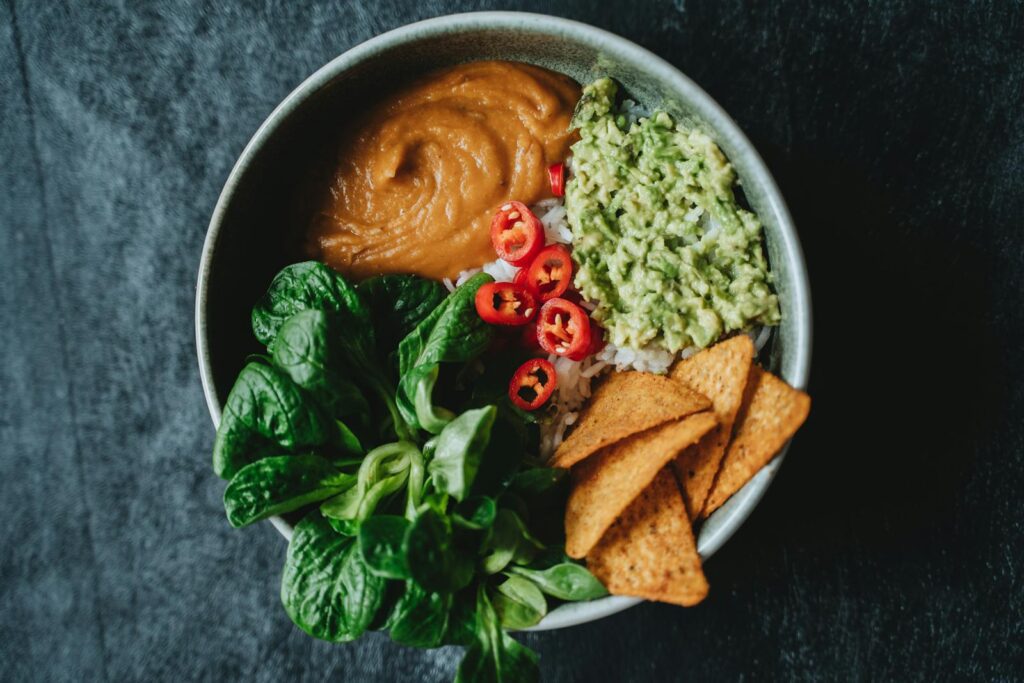
Gimbap, Bibimbap, Jeon: Vegan Ordering at Any Korean Restaurant
When a dedicated venue is hard to find, you can still order vegan Korean food at regular kimbap shops and hanjeongsik houses. The key is knowing standard Korean seasoning and broth patterns and asking precisely.
- Gimbap — “Please remove ham, fish cake, crab stick, and egg — vegetables only.” A vegetable gimbap with spinach, carrot, cucumber, burdock, and danmuji radish is doable. KRW 3,000-5,000 per roll.
- Bibimbap — “No meat, add tofu or mushrooms, gochujang on the side.” Some shops use anchovy fish sauce in their gochujang — ask for soy-based seasoning instead.
- Janchi Guksu / Bibim Guksu — Anchovy broth is the default. Ask “Do you have a vegetable broth option?” For bibim guksu, check whether the sauce includes fish sauce.
- Pajeon / Buchujeon — Seafood often goes into the batter. Order “buchujeon only, no seafood,” or pick gamjajeon (potato) or nokdujeon (mung bean) instead.
- Tteokbokki — Ask to remove fish cake and egg, keeping only rice cake and vegetables. A few vegan tteokbokki shops use plant-based fish cake.
- Kimchi — 99% of mainstream kimchi contains salted shrimp or anchovy sauce. Buy temple kimchi or vegan-certified kimchi separately at marts.
Bridging the Language Gap: Vegan Korean Ordering Phrases
At regular restaurants outside dedicated venues, clear communication matters most. Many shops still have no English menu, so showing a Korean sentence on your phone screen is the most reliable method. Screenshot these phrases and you will be understood in 95% of situations.
- “저는 채식주의자입니다. 고기·생선·해산물·계란·우유·멸치 육수·액젓 모두 못 먹어요.” (I am vegan. No meat, fish, seafood, eggs, dairy, anchovy broth, or fish sauce.)
- “I am vegan. No meat, no fish, no seafood, no eggs, no dairy, no fish broth, no fish sauce. Please.”
- “이 음식에 멸치 육수가 들어가나요?” / “Does this contain fish broth?”
- “비건 메뉴 있나요?” / “Do you have a vegan menu?”
Apps and communities such as HappyCow, Vegan Cafe Korea, and Chaesik Han-kki let you find a Korean vegetarian restaurant near you in advance, which makes route planning much easier. To learn more about traditional Korean side-dish seasonings, see the Korean Banchan Culture Guide.
Local Markets and Vegan Korean Ingredients Shopping
If your accommodation has basic cooking tools, traditional markets and big-box marts (E-Mart, Homeplus, No Brand) are great for buying vegan Korean food ingredients directly. Korean tofu, soybean sprouts, spinach, shiitake, daikon, and napa cabbage are easy to source. You will also find vegan-certified ramyeon (Nongshim vegan, Ottogi chaegaejang), vegan kimchi (Pulmuone vegan), and even vegan dumplings.
Sauce shopping note: most gochujang, doenjang, and soy sauce are vegan, but some ssamjang, cheonggukjang, and dashida packets contain anchovy or shrimp powder. Check labels for “멸치” (anchovy), “새우” (shrimp), “오징어” (squid), “치즈” (cheese), “우유” (milk), and “젓갈” (salted seafood). Products with Pulmuone, Sempio, or CJ vegan-certified marks are the safest pick.
Vegan Korean Cooking Class Experiences
If your trip has room for it, try a vegan Korean cooking class. English-language vegan Korean cooking classes run in Insadong (Seoul), Gwangalli (Busan), and downtown Jeju. Sessions last 2-3 hours at KRW 50,000-90,000 per person, teaching recipes like temple bibimbap, soy bulgogi, mushroom mandu soup, and eggplant sweet-and-sour — all classic vegan Korean food.
Book through Visit Korea, Klook, or Trazy. Temples like Jingwansa and Bongeunsa even run their own dedicated temple-cuisine classes. For general Korean cooking class info, see the K-Food Cooking Class Complete Guide.
Frequently Asked Questions (FAQ)
- Q. Will Korean restaurants understand “vegan”?
A. The word “vegan” works in 70-80% of urban venues. Outside cities, it is safer to spell it out: “no meat, no fish, no eggs, no dairy.” - Q. What is the difference between temple food and vegan?
A. Temple cuisine also excludes the 5 alliums (garlic, scallion, chive, wild garlic, onion), making it stricter than vegan. Vegan diets allow alliums. - Q. Is Korean kimchi vegan?
A. About 99% of supermarket kimchi contains salted shrimp or anchovy sauce and is not vegan. Buy temple kimchi or vegan-certified kimchi separately. - Q. What is the budget for a Korean vegetarian restaurant?
A. Vegan café KRW 12,000-20,000, vegan hanjeongsik KRW 25,000-50,000, temple-cuisine course KRW 60,000-120,000 per person. - Q. Which city is safest for foreign vegan travelers?
A. Seoul (Itaewon, Hongdae, Sinsa), Busan (Haeundae, Seomyeon), and Jeju (Aewol, downtown) have the highest density of vegan venues.
Final Checklist for Your Korean Vegetarian Restaurant Trip
Korean cuisine relies heavily on seasonings and broths, so going in unprepared can be tough, but with three pillars — temple cuisine, vegan cafés, and confident ordering at regular restaurants — a Korean vegetarian restaurant trip is absolutely enjoyable. Doenjang jjigae becomes a fine vegan Korean food choice when you swap anchovy broth for shiitake and kelp stock, and sundubu jjigae can deliver deep umami with only vegetables, no seafood.
Before departure, install HappyCow and Vegan Cafe Korea, screenshot the Korean vegan prompt card, and combine one temple-cuisine course + 2-3 vegan cafés + confident vegan ordering at regular restaurants. With this set, even a 7-day itinerary offers a varied Korean vegan trip. Travelers with religious or cultural dietary restrictions can also consult the Halal and Kosher Restaurant Guide.
For up-to-date vegan venue lists and certifications, see the Korea Vegetarian Union and the Korea Tourism Organization.
K-Name Studio: Create your perfect Korean name based on your personality and style.
What’s My K-Beauty Personal Color?
WeBring Service : Provides personalized services to foreigners living in Korea
Exclusive offer: Introducing foreign car rental in Korea, WeBring-SoCar
- Korean Vegetarian Food Guide: Temple Cuisine, Vegan Restaurants, and How to Eat Plant-Based in Korea
- Vegan Restaurants Seoul: Complete Guide to Gluten-Free Dining in Korea
- Temple Cuisine: Discover the Healthy Secrets of Korean Buddhist Food
- Traditional Korean Kimchi Types: A Complete Guide
Last updated: 22 September 2026
Prices, opening hours and transport schedules change with the season and the operator. Check the official channel again before you go.
WeBring operates its own Korea tour and vehicle services. The following is a promotion for that service.
Explore Korea's mountains — guides in your language
Courses, transport and seasonal tips for 30 mountains, from Bukhansan to Hallasan, available in 11 languages. Pick up essential travel Korean and find events for the global community, too.