


Making Korean friends is the decisive factor that shapes the quality of your study-abroad life in Korea. Frequent conversations with locals are essential to close the gap between the Korean you learned in the classroom and the spoken Korean used on the street. Pronunciation, intonation, slang, and the cultural nuances that only Koreans understand can ultimately be absorbed naturally only by making friends. This guide covers proven channels for making Korean friends — random chat apps, clubs, offline meetups, fandom activity — and walks you through ice-breaker conversation topics and Korean etiquette for the first meeting.
Making Korean Friends: Why Local Friends Matter
Daily conversation with Korean friends lets you absorb vocabulary, pronunciation, intonation, and cultural nuance all at once. Exam tips, part-time job openings, studio rental prices, and neighborhood restaurants — the practical information that directly affects your day-to-day life travels fastest through friends. More than anything, the simple fact that there is a local you can text on a homesick night is a powerful antidote to loneliness.
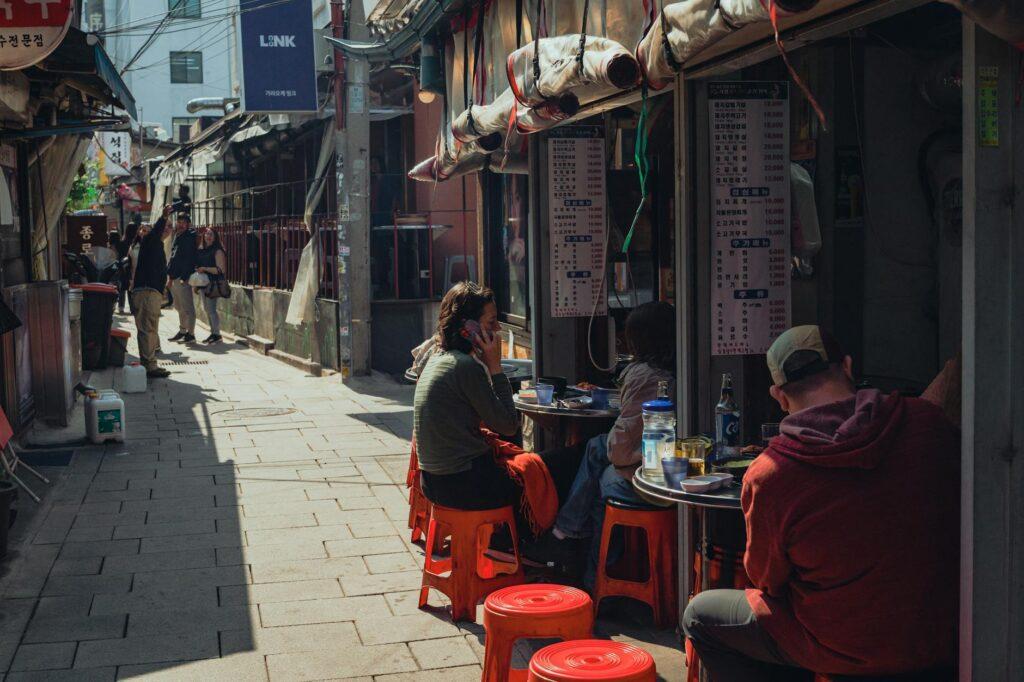
Making Korean friends is not just language practice but the start of real cultural exchange. Walking together through cultural spots like Bukchon Hanok Village, or sharing street food in a market alley, becomes living education that no textbook can offer. The memory of the places and food you experienced with a friend gives emotional weight to every Korean word you later use — that is the deepest payoff.
These services work differently: HelloTalk and Tandem focus on language exchange, while MEEFF is a social-discovery service connecting people interested in Korea. They should not all be described as random one-to-one matching. Search and nearby features depend on the app and plan; a profile or match does not verify a person’s identity or guarantee an offline meeting. Tandem’s rules explicitly say it is not a dating app.
- Pros: You can start chatting without time or location constraints and meet Koreans across many regions, ages, and occupations in a short time.
- Cons: Identities are unverified and dating motives may be mixed in, so be careful with personal information and always set your first in-person meeting in a public place.
- Profile tip: State your language level, interests and exchange goals in a short introduction. This helps others judge whether your goals fit; it does not guarantee more replies.
Offline Channels for Making Korean Friends: Clubs and Local Meetups
If you want to make friends face-to-face, use a school club or a local meetup. In cultural, sports, or volunteer clubs you naturally collaborate with Koreans toward a shared goal, and friendships build along the way. International exchange clubs that welcome foreign students have a low entry barrier and are especially suitable as your first club.
Study cafe meetups in Hongdae, language exchanges in Itaewon, book clubs, hiking and running clubs are posted every week on Twitter, Instagram, and KakaoTalk open chat rooms. Meetup.com is another useful platform with many foreigner-friendly groups active in Seoul, Busan, and Daejeon. If you keep attending the same meetup every one or two weeks, you transition from being a stranger to a regular member, and from that point real friendships develop quickly.
Variety Shows, Music, and Hobby-Based Groups
K-POP, variety show, and drama fan meetups are built on a shared passion, so there is almost no awkwardness at first contact. Find fan club or fan meeting announcements on Twitter and Instagram, show up at offline events, and conversations like “Want to go shop for goods together?” or “How do you read this lyric?” come up naturally. Hobby groups around exercise, running, or cycling are equally effective for making Korean friends and tend to last because they meet on a regular cadence.

Best Conversation Topics for Making Korean Friends
With a Korean you have just met, start with light common-interest questions. “What hobbies do you enjoy?” or “Any drama you have liked lately?” are safe topics that open a conversation without pressure. Food is another nearly universal opener. Try “What is your favorite Korean food?” or “Do you often have chimaek (fried chicken with beer)?” — these naturally lead to restaurant recommendations and a follow-up appointment to actually go there together.
Cultural differences and study or career topics also work well. With a university friend you can talk about majors, exams, and job hunting; in return, sharing your home country’s work culture, salary levels, and office atmosphere gives them an interesting outside view. A walk through downtown alleys such as Insadong and Ikseondong is a perfect filler for time with a new friend, as the scenery itself feeds conversation.
Making Korean Friends with Etiquette and the Right Attitude
Korean culture defaults to honorifics (jondaetmal) when meeting someone new. Use the “-yo” verb endings and hold back on sensitive topics like politics, religion, and income for the first few meetings. Naturally weaving in considerate phrases like “If it is not rude to ask” or “Please tell me if you are uncomfortable” raises your likability quickly.
If you proactively say “I am still learning Korean and may make mistakes — I want to learn banmal (casual speech) too,” and your friend answers “Sure, let’s relax then,” the relationship gets noticeably closer in that exact moment. In making Korean friends, what matters most is finally respect and consideration, and these build trust much faster than language skill alone.
Overcoming Difficulties in Making Korean Friends
- Language barrier: Translation apps, simple phrases and gestures can support conversation. Progress depends on your starting level, practice and the other person; there is no one-month guarantee.
- Scheduling: Even a once-a-week KakaoTalk check-in with photos preserves the relationship when you cannot meet in person.
- Cultural differences: When you encounter an unfamiliar custom, ask openly and apologize for not knowing. Most Korean friends will explain it kindly.

Check the Study in Korea portal and your university’s international office for current exchange opportunities. Mentoring, language exchanges and campus tours depend on the institution, recruitment period and eligibility.
The Real Help a Korean Friend Provides
Once you have a Korean friend, the administrative tasks that are hard to handle alone as a foreigner — opening a bank account, activating a mobile phone, signing a studio lease, going to a hospital — become dramatically easier. Keep your self-reliance, but accept help in the moments where you genuinely get stuck, and you cut both time and stress sharply. Reciprocate by using whatever languages you speak (English, Chinese, Japanese, and so on) to help your friend with foreign materials, and a natural win-win relationship forms.
Completing Your Study Abroad by Making Korean Friends
It is a waste if studying abroad ends inside the classroom. Steady exchange with Korean friends teaches you not only the language but also culture, daily lifestyle, and the atmosphere of real workplaces, filling out your study-abroad experience. Try several channels at once — random chat apps, school clubs, local meetups, fan clubs, sports clubs — and meet as wide a range of people as you can. The key to making Korean friends is not relying on a single channel.
The first few weeks may feel awkward, but with time, natural exchange becomes possible. Hunting for restaurants together, taking weekend trips, and cheering each other on through exam season — you gain not just Korean fluency but lifelong connections along the way.
K-Name Studio: Create your perfect Korean name based on your personality and style.
What’s My K-Beauty Personal Color?
WeBring Service : Provides personalized services to foreigners living in Korea
Exclusive offer: Introducing foreign car rental in Korea, WeBring-SoCar
Sources checked (2026-09-08): 1, 2, 3.
Last updated: 16 September 2026
Rules, fees and procedures can change over time. Before an important decision, check the latest guidance from the relevant authority.
WeBring operates its own services for foreign residents in Korea. The following is a promotion for those services.
Living in Korea? You don't have to figure it out alone
Insurance, visas, jobs and hospital interpretation — WeBring supports every step of settling in Korea, in your language.