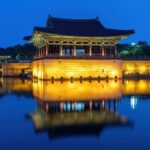


To see Gyeongju autumn foliage most efficiently in a single day, the answer is the Bulguksa area on the slopes of Mount Toham. In autumn, the maples by Cheongun-gyo and Baegun-gyo, the water reflections at Banya-yeonji pond, and the 2.2 km maple tunnel trail from Iljumun gate to Seokguram offer different autumn views. This guide consolidates Gyeongju autumn foliage peak timing, the top 5 Bulguksa photo spots, recommended courses, hours, fees and transport in one place.
Why Bulguksa Is the #1 Spot for Gyeongju Autumn Foliage
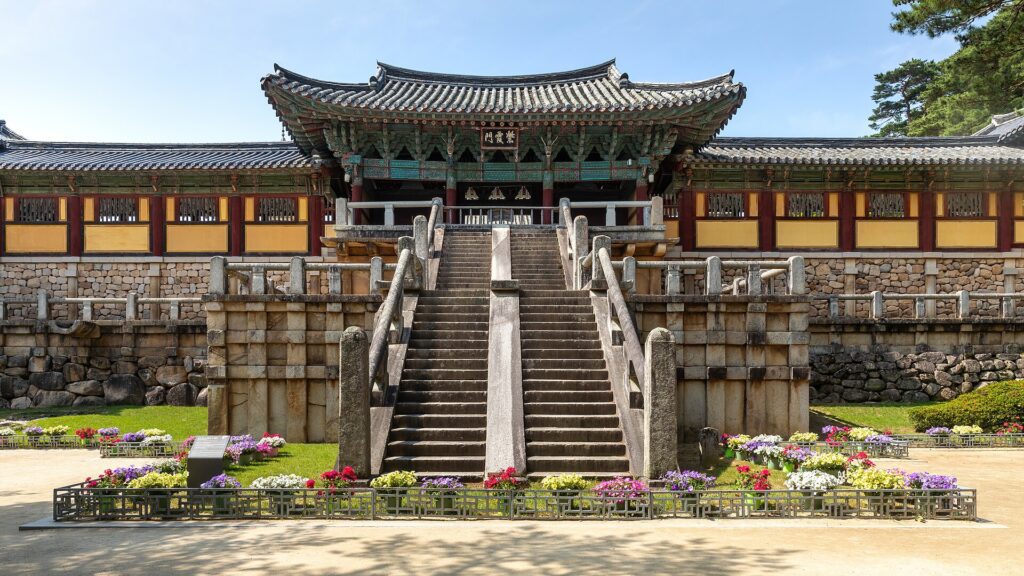
Bulguksa and Seokguram were jointly inscribed as a UNESCO World Heritage Site in 1995, and both sit inside the Toham Mountain district of Gyeongju National Park. You can capture the stone architecture of the Silla millennium and mountainside maples in the same frame, which makes this zone the densest single Gyeongju autumn foliage destination. Downtown spots like Nodong-dong’s ginkgo street or Daereungwon are nice, but no place beats Bulguksa for information density per photo and route efficiency.
Foliage timing differs between the mountainside and downtown, and varies with the year, elevation and tree species. Plan broadly around late October and November, then check recent local images and weather. Neither a fixed 5–7 day lead nor a first-week-of-November peak is guaranteed. Bulguksa’s current admission starts at 09:00; check parking and allow extra time on busy weekends.
If you only have one day for Gyeongju autumn foliage, the priority order is clear: Bulguksa Cheongun-gyo and Baegun-gyo → Banya-yeonji pond → Daeungjeon and Dabotap → Iljumun-to-Seokguram trail. This sequence covers all photo spots and the maple tunnel in one continuous route.
Gyeongju Autumn Foliage Peak Timing & Admission
No exact 2026 peak date has been verified for this guide. Use current local foliage reports and weather forecasts close to departure; temperature alone does not justify a fixed five-to-seven-day adjustment. Check national park access notices separately before adding a mountain trail.
Bulguksa and Seokguram have waived the former cultural-property admission since May 4, 2023; do not budget for separate or combined admission tickets. Both official sites list admission from 09:00, ending at 18:00 in March–September, 17:30 in February and October, and 17:00 in November–January. These are published admission deadlines, not permission to remain until 19:00. Parking is separate: cars KRW 2,000 and buses KRW 4,000 at each site.
| Item | Bulguksa | Seokguram |
|---|---|---|
| Fall hours | 09:00 admission; Sep18:00 / Oct17:30 / Nov17:00 deadline | 09:00 admission; Sep18:00 / Oct17:30 / Nov17:00 deadline |
| Adult admission | Free cultural-property admission | Free cultural-property admission |
| Parking | Cars 2,000 / Bus 4,000 KRW | Cars 2,000 / Bus 4,000 KRW; separate parking charge |
| Closure | Open year-round | Open year-round |
| Phone | 054-746-9913 | 054-746-9933 |
Bulguksa Top 5 Gyeongju Autumn Foliage Photo Spots
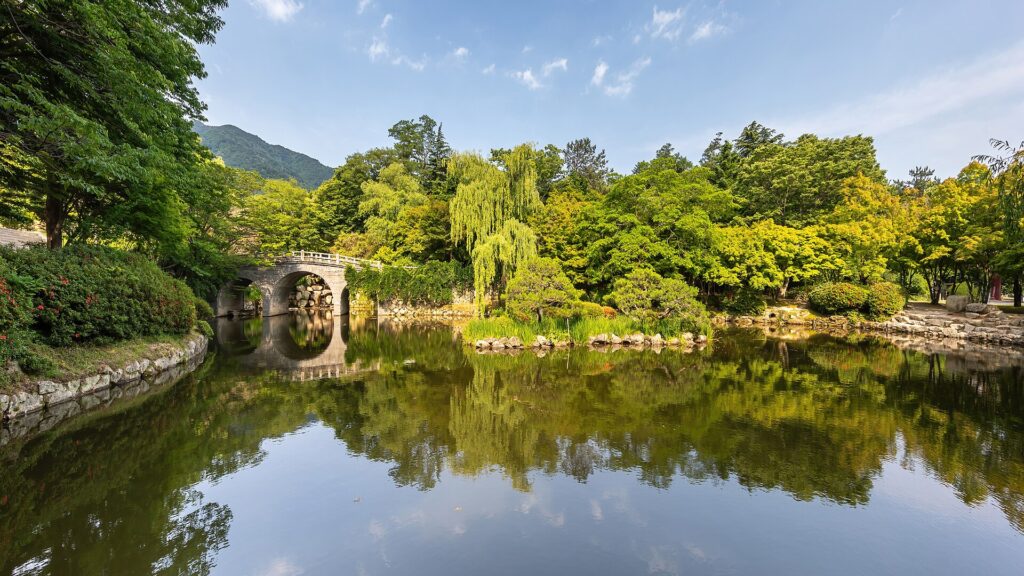
To capture Gyeongju autumn foliage most efficiently, walk these five zones in entry order. The full loop — Cheongun-gyo and Baegun-gyo, Banya-yeonji, Daeungjeon, Gwaneumjeon and the Iljumun approach trees — takes 60–90 minutes on foot.
| Photo Spot | Main Trees | Best Time | Tip |
|---|---|---|---|
| Cheongun-gyo & Baegun-gyo | Maples | After 09:00 opening | Photograph the protected stone stairs from permitted viewing areas; color varies with the date |
| Banya-yeonji pond | Maple & pine | After 09:00 opening | Water reflection on calm days; fog is weather-dependent |
| Daeungjeon courtyard | Ginkgo, zelkova | 09:00–11:00 | Yellow ginkgo and red maple in one frame with Dabotap and Seokgatap pagodas |
| Gwaneumjeon / Birojeon rear | Maples | 14:00–16:00 | Highest spot in the precinct; use telephoto for compression |
| Iljumun approach | Roadside maples | 16:00–17:00 | Afternoon side light makes the avenue maples glow strongest |
The Daeungjeon courtyard, where Dabotap and Seokgatap pagodas face each other, is the most-photographed Gyeongju autumn foliage scene. A standard to short-telephoto lens (35–85 mm equivalent) keeps the pagodas and maples in the same plane and emphasizes the Silla-era stonework against the fall colors. A wide-angle wash tends to lose both subjects.
Gwaneumjeon hall is the highest point inside the precinct and offers a top-down view of the rear courtyard’s color distribution. Crowds are thinnest on weekday afternoons after 2 p.m. The maple tunnel passes through here too, so it is worth waiting at one spot as the side-lighting changes.
Iljumun to Seokguram Maple Tunnel Trail (2.2 km one-way)
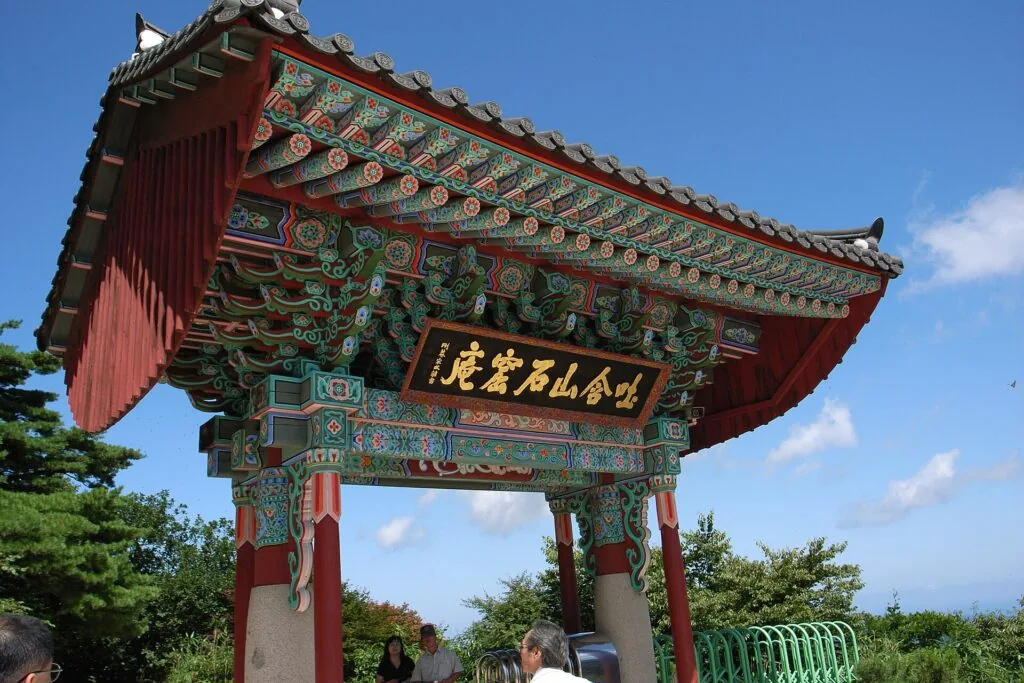
The Bulguksa–Seokguram approach is a mountain trail with uphill sections and stone steps, not a universally easy walk. The roughly 2.2 km approach does not include every step of the grotto visit. Allow extra time for gradients, breaks and photography, and check the actual trailhead and closure notices. Carry drinking water and use marked paths around Odongsu. Confirm conditions with the park before setting out.
- Start at the signed Bulguksa-side trailhead — check the route and uphill sections
- Reach the Odongsu area — peak maple tunnel begins, carry drinking water; do not drink spring water without a current potable-water notice
- Continue toward Seokguram’s entrance area — allow time for slopes and the separate grotto approach
- Arrive at Seokguram (allow sufficient uphill walking time) — view the main Buddha
- Descent — Bus 12 back to Bulguksa or walk back the same trail (4.4 km round trip)
Look for autumn color along the marked route beyond Odongsu; the best color changes with the season. With backlight the leaves seem to glow, so 10–11 a.m. or 3–4 p.m. is the photographic golden hour. If your knees are weak, bring trekking poles. Stone steps with fallen leaves can be slippery, so non-slip sneakers or trekking shoes are recommended.
Three Gyeongju Autumn Foliage Courses by Difficulty
Pick a course based on time and stamina. Course A suits families and parents; Course B is the standard photography route; Course C extends to an overnight healing stay.
| Course | Duration | Difficulty | Route |
|---|---|---|---|
| A — Quick | 2–3 hours | Easy | Bulguksa (Cheongun-gyo → Banya-yeonji → Daeungjeon → Gwaneumjeon) + Buldan-gil cafés |
| B — Standard half-day to full day | 5–7 hours | Moderate | Top 5 Bulguksa photo spots → Iljumun-to-Seokguram trail (2.2 km) → Odongsu maple tunnel → Seokguram → Bus 12 back |
| C — Overnight extension | 1 night, 2 days | Moderate | Course B + Toham Mountain Recreation Forest stay or Bomun Lake night views |
For families, Course A’s precinct loop plus a Buldan-gil lunch is comfortable. For photographers, Course B is the way: entry after the current 09:00 opening → five photo spots → Iljumun-to-Seokguram trail → Seokguram by 1 p.m. → Bus 12 return is the most efficient sequence. For full route logistics, see Gyeongju 2-Day Public Transport Itinerary.
Gyeongju Autumn Foliage Trip Transport & Parking
The current KTX station is named Gyeongju Station (formerly Singyeongju), outside the old downtown station area. Do not assume Bus 10 or 11 departs directly from its KTX stop. Check a current Bulguksa-bound connection such as an eligible Bus 700 trip or a transfer. From downtown, verify the exact Bus 10/11 stop and direction. For Bus 12, consult both seasonal departure lists before hiking; October–February last trips are earlier than the summer service. Car parking at Bulguksa is KRW 2,000; congestion varies.
- KTX — From KTX Gyeongju (formerly Singyeongju), check the actual Bus 700 trip or transfer and allow waiting time
- Express bus — From Gyeongju Express Terminal, Bus 10 or 11 (30–40 min)
- Car — Bulguksa Parking Lot 1 (KRW 2,000 compact); arrive before 9 a.m. on peak weekends
- Taxi — quote a route from the current KTX Gyeongju Station, not the former downtown station; allow for traffic
For a one-day trip seeing both sites, the most efficient route is Bulguksa → Seokguram → Bus 12 back. Allow at least four hours for both with breathing room. If you are also planning a non-foliage season trip, see Korea Spring Cherry Blossom Best 5 (incl. Gyeongju) for season comparisons.
Practical Tips for Gyeongju Autumn Foliage Visitors
Use recent local foliage photos, weather and access notices to decide when to visit. A late afternoon start is unsuitable for the mountain extension when admission and return buses finish early. If you arrive late, limit the plan to sites still open and leave before local access closes.
In the first week of November, daytime temperatures around Bulguksa hover near 10°C and early mornings and evenings can drop below 5°C. For the trail, a windbreaker or light down and non-slip sneakers or trekking shoes are advisable. Tripods inside the precinct are sometimes restricted by safety staff on peak weekends — bring a stabilized camera or smartphone instead.
- Clothing — Layered, with windbreaker or light down; non-slip sneakers
- Gear — Skip the tripod; use a stabilized camera/phone and one telephoto
- Meals — Gyeongju ssambap and Hwangnam-bbang near the Bulguksa parking lot
- Rainy days — check warnings and closures; skip the mountain trail in hazardous rain
- Side trips — Buldan-gil cafés and craft shops, or Toham Mountain Recreation Forest for a forest-bath stay
Gyeongju Autumn Foliage FAQ
Q. When exactly does Gyeongju autumn foliage peak?
Late October and November are broad planning periods; exact color and timing vary by year and tree species. Check recent local conditions rather than treating the first week of November as a guaranteed peak.
Q. Can I see both Bulguksa and Seokguram in one day?
Yes. The most efficient route is entry after the current 09:00 opening to Bulguksa → top 5 photo spots → 2.2 km Iljumun-to-Seokguram trail → Seokguram → Bus 12 back.
Q. Is it doable without a car?
Yes. Check the actual station or terminal connection to Bulguksa; Bus 10/11 does not directly serve the KTX station. Then use Bus 12’s seasonal departure list or an open mountain trail with enough daylight and walking time.
Q. Is rain a deal-breaker?
Check weather alerts and access restrictions first. Seokguram may close during heavy-rain, typhoon or snow warnings. Skip the mountain trail in hazardous weather; waterproof shoes do not make slippery steps safe.
Image Credits
- Featured image: kynlin / Wikimedia Commons (CC BY-SA 4.0)
- Banya-yeonji reflection: Basile Morin / Wikimedia Commons (CC BY-SA 4.0)
- Dabotap pagoda: Eggmoon / Wikimedia Commons (CC BY-SA 3.0)
- Bulguksa entrance: Basile Morin / Wikimedia Commons (CC BY-SA 4.0)
- Seokguram Iljumun: Steve46814 / Wikimedia Commons (CC BY 2.0)
K-Name Studio: Create your perfect Korean name based on your personality and style.
What’s My K-Beauty Personal Color?
WeBring Service : Provides personalized services to foreigners living in Korea
Exclusive offer: Introducing foreign car rental in Korea, WeBring-SoCar
Sources checked (2026-09-08): 1, 2, 3, 4, 5.
Last updated: 16 September 2026
Prices, opening hours and transport schedules change with the season and the operator. Check the official channel again before you go.
WeBring operates its own Korea tour and vehicle services. The following is a promotion for that service.
Explore Korea's mountains — guides in your language
Courses, transport and seasonal tips for 30 mountains, from Bukhansan to Hallasan, available in 11 languages. Pick up essential travel Korean and find events for the global community, too.