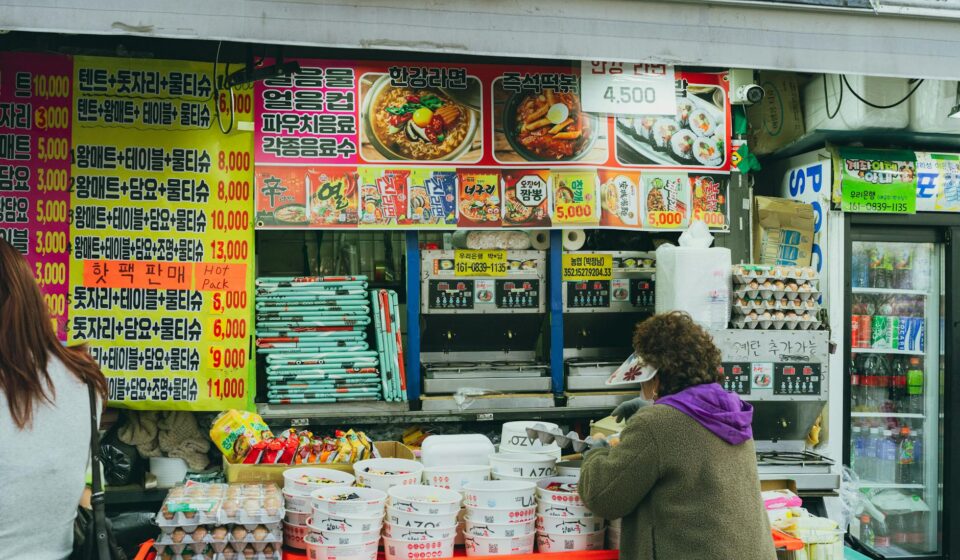

If Korea market shopping is new to you, the unmarked produce, the tasting samples, and the surprise charge for a plastic bag will all stop you in your tracks. This guide gives foreigners a real-world routine for both traditional markets and hypermarkets — without getting overcharged or feeling awkward.
- “No price tag — am I supposed to bargain?“
- “They are offering a sample — can I really taste it?“
- “I asked for a bag and got charged for it?“
- “Why does everyone pack their own groceries at the mart?”
The reason Korea market shopping feels so confusing is that traditional markets (sijang) and hypermarkets / supermarkets (mart) follow completely different rules. Markets run on people and conversation; marts run on price tags and systems.
Korea market shopping in 1 minute: do this from today
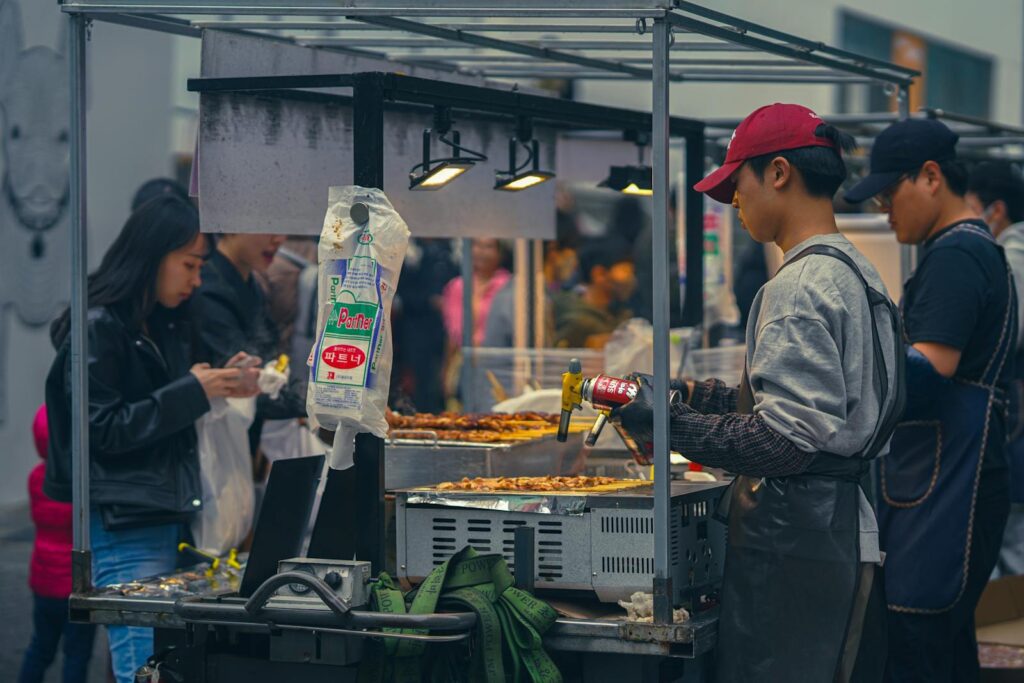
- Traditional market: Bargaining is sometimes possible — asking for service (deom, a freebie) feels more natural.
- Hypermarket: No bargaining — price tags, deals (1+1) and membership are what matter.
- Sampling: Mostly OK, but keep it to one small bite plus a thank-you.
- Packing / bags: Rules vary by store — one eco-bag solves almost everything.
- Payment: Cards work almost everywhere, but cash often goes further at markets and flea markets (VISITKOREA).
Traditional market vs hypermarket: Korea market shopping rules side by side
| Item | Traditional market | Hypermarket / supermarket / convenience store |
|---|---|---|
| Pricing | Some stalls have no price tag (varies by shop) | Tag = fixed (digital) |
| Bargaining | Sometimes works (especially with bundle buys) | Almost never |
| Freebie (service) | Common | Rare (deals or coupons instead) |
| Sampling | Rice cakes, fruit, side dishes — “try a bite” is common | Sampling stations (by store and time) |
| Packing | Vendor often packs for you | You usually pack it yourself after checkout |
Korea market shopping bargaining: where and how it feels natural
Where bargaining feels natural
- Traditional markets, flea markets, and some street stalls
- Official tourism guides explicitly suggest bring cash and try bargaining at flea markets (VISITKOREA FR).
Where bargaining feels awkward (and you lose face)
- Hypermarkets, chain supermarkets, convenience stores, and department stores: the price tag is final. Trying to bargain feels out of place.
The real point of markets: not discounts, but freebies (service)
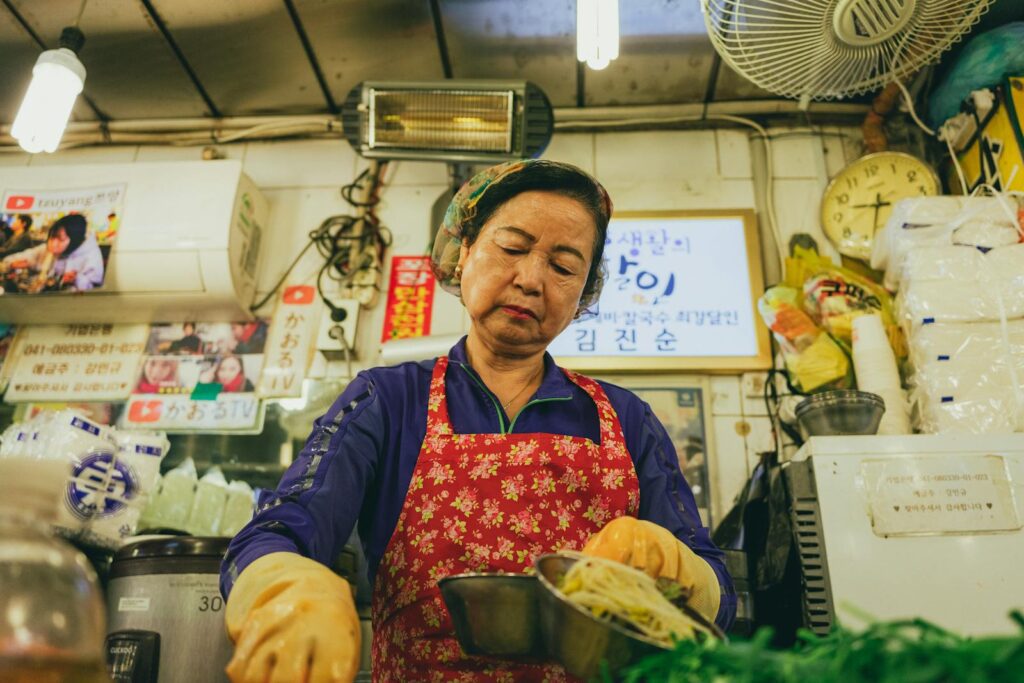
What people really praise about Korean traditional markets is the mix of jeong (warmth) and deom (a little extra). The Korean Government Briefing also calls deom “a symbol of generosity and human warmth” found at traditional markets (Korea.kr).
Two opening lines that work well during Korea market shopping. For broader travel context check the Korea Tourism Organization.
- “Kkakka juseyo!” (Please give me a discount.) — direct, strong tone
- “Service jom juseyo?” (Could I get a little extra?) — softer, almost always fine
Beginner phrasing with the highest success rate
- “If I buy two, can you give me a little more off?”
- “If I buy three, do I get a freebie?”
- “Any discount for cash?” (only when cash payment feels welcome)
Tip: In Korea market shopping, bargaining is a light trade conversation, not a fight. Stay friendly and you stay safe.
Korea market shopping tasting culture: free, but follow 3 rules
Sampling is common in many places, but stick to these three rules and you will be fine.
- Ask first: “Sisikhae-do dwaeyo?” (May I taste this?)
- One bite, one time
- Always finish with: “Gamsahamnida!” (Thank you.)
Can I taste and walk away without buying?
Mostly yes, but two things to remember:
- Repeat sampling at the same stall is considered rude in Korea too.
- If you like it, buy something small — your next visit gets much warmer.
Korea market shopping packing culture: bags, boxes, and self-pack stations
“Do you need a bag?” usually means it is not free
Korea’s single-use and bag policies have been enforced, eased, and modified at various times, so “paid here, alternative bag there, none at all over there” all coexist. The Ministry of Environment has long restricted plastic bags at large stores and certain supermarkets and pushed broader single-use reduction policy (Ministry of Environment).
Around November 2023, parts of those single-use rules were also reported as shifted toward voluntary guidance or postponed (paper cups, straws, plastic bags) (Korea JoongAng Daily).
Foreigner-friendly answer: one folding eco-bag and one cooler bag covers nearly all of Korea market shopping.
Market packing: just say “don’t let it leak”
Especially when buying side dishes, kimchi, salted seafood, or anything with broth, these lines work well.
- “Please pack it so it doesn’t leak.”
- “Please double (or triple) the plastic.”
- “Just a little broth, please.”
Mart packing: you pack it (and tape may be missing)
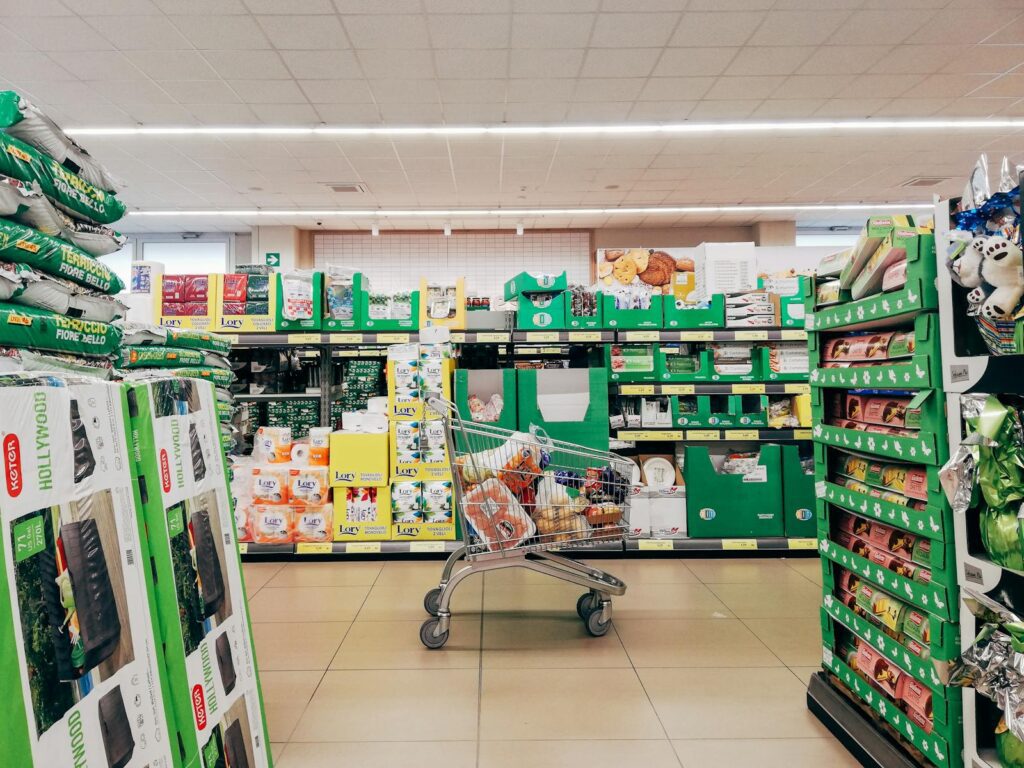
At hypermarkets, customers usually pack their own bags after checkout. Some chains have changed how their self-pack stations operate, so tape and string are not always provided (Hani).
The smooth self-pack routine looks like this:
- Pass through checkout
- Move to the packing area and load your own bag or eco-bag
- Use a box if available for heavy items
- Use a cooler bag first for chilled and frozen goods
Korea market shopping payment culture: card vs cash
Cards work in most places
Official tourism information (VISITKOREA) explains that you can travel and shop in Korea “with just a credit card” and that most places accept cards, except a few small family-run shops (VISITKOREA).
Where cash still wins
- Flea markets: official guides recommend bring cash, since most stalls work in cash (VISITKOREA FR).
- Some street stalls in markets: a few have no card terminal at all.
Transit cards can also help with small purchases
VISITKOREA notes that transit cards such as T-money offer transfer discounts on public transport and can also be used for some online and offline purchases (acceptance varies by card and merchant) (VISITKOREA).
“Price per 100g” or “price per pack”? Always check
Common labels in the meat and side-dish corners look like this:
- 2,500 KRW per 100g
- 9,900 KRW per pack
- 1+1 / 2+1 promotion
Two safe questions:
- “Is this the price for 100g or for one pack?”
- “What’s the total?”
A geun (斤) varies by product (this matters)
According to the National Institute of Korean Language’s online Q&A (citing the Standard Korean Dictionary):
- Meat / herbal medicine: 1 geun = 600g
- Fruit / vegetables: 1 geun = 375g (National Institute of Korean Language).
The safest move during Korea market shopping is to ask in g or kg instead of geun.
- Instead of “How much per geun?” → “How many grams?” / “How much per kg?”
Real-life mini scripts (just read them off)
(1) Fruit stall: bundle plus a freebie
- You: How much for one pack?
- Vendor: “10,000 won.”
- You: If I buy two packs, can you take a little off?
- Vendor: “18,000 won.”
- You: Sounds good. One bag, please. Card OK?
(2) Side-dish shop: “don’t let it leak”
- You: How much for 200g of this?
- You: Please pack it so it doesn’t leak. Double the plastic, please.
(3) Mart: keeping your cool at the bag and pack station
- Cashier: “Do you need a bag?”
- You: No, thanks. (Pull out an eco-bag.)
- You: Receipt, please.
Korea market shopping must-know phrases (20 essentials)
| Situation | Korean | Romanization | Meaning |
|---|---|---|---|
| Price | 이거 얼마예요? | i-geo eol-ma-ye-yo? | How much? |
| Unit | 1kg에 얼마예요? | il-ki-lo-e eol-ma-ye-yo? | Price per kg |
| Unit | 몇 그램이에요? | myeot geu-raem-i-e-yo? | How many grams? |
| Total | 총 얼마예요? | chong eol-ma-ye-yo? | Total? |
| Bargain | 조금만 깎아주세요 | jo-geum-man kkak-a-ju-se-yo | A small discount |
| Bundle | 두 개 사면 할인 돼요? | du-gae sa-myeon hal-in dwae-yo? | Discount for 2? |
| Freebie | 서비스 좀 주세요 | seo-bi-seu jom ju-se-yo | A little extra please |
| Sampling | 시식해도 돼요? | si-sik-hae-do dwae-yo? | May I taste? |
| Choice | 이걸로 주세요 | i-geol-lo ju-se-yo | This one, please |
| Quantity | 한 개 더 주세요 | han-gae deo ju-se-yo | One more |
| Packing | 포장해 주세요 | po-jang-hae ju-se-yo | Please pack it |
| Leak | 안 새게 포장해 주세요 | an sae-ge po-jang-hae ju-se-yo | Don’t let it leak |
| Bag | 봉투(봉지) 주세요 | bong-tu(bong-ji) ju-se-yo | Bag please |
| Bag refused | 봉투 필요 없어요 | bong-tu pi-ryo eop-seo-yo | No bag needed |
| Payment | 카드 돼요? | ka-deu dwae-yo? | Card OK? |
| Payment | 현금 돼요? | hyeon-geum dwae-yo? | Cash OK? |
| Receipt | 영수증 주세요 | yeong-su-jeung ju-se-yo | Receipt please |
| Thanks | 감사합니다 | gam-sa-ham-ni-da | Thank you |
| Decline | 괜찮아요 | gwaen-chan-a-yo | I’m OK |
| Goodbye | 다음에 올게요 | da-eum-e ol-ge-yo | I’ll come again |
10-second checklist before you leave home
- Eco-bag or shopping bag
- (Summer / frozen) cooler bag
- “Confirm the unit”: kg? 100g? 1 pack?
- At markets, ask for service (deom) rather than slashing the price
- Sample once, then say “Gamsahamnida”
- Some cash on hand (insurance for markets and flea markets) (VISITKOREA FR)
Korea market shopping FAQ
Q1. Is bargaining at Korean traditional markets considered rude?
Some places — like flea and second-hand markets — bargain freely, and official tourism guides actively suggest “try haggling.” Where price tags are clear, a softer line like “Discount if I buy two?” works better (VISITKOREA FR).
Q2. What exactly is the “service” at Korean markets?
Instead of cutting the price, vendors often add a little extra (deom). A government article also describes deom as a hallmark of warmth at traditional markets (Korea.kr).
Q3. Is it OK to taste samples and not buy?
Mostly yes — keep it to one taste, small bite, and a thank-you and the mood stays friendly.
Q4. Why do I have to pay for a plastic bag?
Single-use reduction policies and store practices mean bags are not always free, and rules can change. The government has both pushed restrictions and later eased some of them. The reliable answer is to carry an eco-bag (Ministry of Environment).
Q5. Why do I have to pack my own groceries at the mart?
Hypermarkets typically run a “self-pack” model — you pack after the cashier rings you up. Some chains have also changed how their packing stations supply tape and string (Hani).
Q6. Are cards accepted almost everywhere?
Official tourism information says most places accept credit cards, except a few small family-run shops. Flea markets are the main cash exception (VISITKOREA).
Q7. Is 1 geun always 600g?
Per the National Institute of Korean Language (citing the Standard Korean Dictionary), it varies (meat 600g, fruit / vegetables 375g). When in doubt, ask in g or kg (National Institute of Korean Language).
K-Name Studio: Create your perfect Korean name based on your personality and style.
What’s My K-Beauty Personal Color?
WeBring Service : Provides personalized services to foreigners living in Korea
Exclusive offer: Introducing foreign car rental in Korea, WeBring-SoCar
- Noryangjin Fish Market Guide: Four-Stage Ordering, Pricing, Menu Pairings
- Tips for living in Korea: Understanding electricity, water, gas, heating, and garbage
- Korean Restaurant Etiquette: Bell, Banchan, Solo Dining & Payment (2026)
- The Unique Charm of Traditional Markets: A Guide to Seoul’s Best Markets
Last updated: 23 September 2026
Rules, fees and procedures can change over time. Before an important decision, check the latest guidance from the relevant authority.
WeBring operates its own services for foreign residents in Korea. The following is a promotion for those services.
Living in Korea? You don't have to figure it out alone
Insurance, visas, jobs and hospital interpretation — WeBring supports every step of settling in Korea, in your language.