
Korean restaurant etiquette becomes effortless once you learn the structural flow. The core of Korean restaurant etiquette is that staff don’t always come to you — instead, the call bell, the self-serve corner, banchan (side-dish) culture, and follow-up orders all run on a natural rhythm. This guide walks through the full path from entry to seating to ordering to payment, and rounds up the 5 mistakes foreigners most commonly make.
The table below summarizes the Korean restaurant etiquette flow you can apply at your next meal.
| Stage | Key phrase | Watch out |
|---|---|---|
| Enter / take a seat | “How many?” greeting / pick any open table | Check entry signs (self-serve, prepay, kiosk) |
| Order | Call bell or “Jeogiyo” | Avoid loud yelling or big gestures |
| While eating | Use a personal plate, share banchan | Don’t stick chopsticks upright or stir shared soup |
| Add-on order | “Gonggibap chuga-yo” (extra rice) | Don’t over-order at the start |
| Pay | “Gyesan-halgeyo” → card | No tipping; counter payment is common |
Korean restaurant etiquette: entry and seating flow
The first step in Korean restaurant etiquette is reading the entry style. Some restaurants greet you with “How many?” and seat you, but pojangmacha-style spots, gukbap shops, kimbap chains, and roadside diners often let you sit at any open table. Look for signs near the door — “self-serve”, “prepay”, or “order at kiosk” — before you sit down. For more foreigner-friendly background, see the Visit Seoul etiquette guide.
- Hosted seating: Hanjeongsik, BBQ houses, mid-to-large restaurants — staff seat you after counting your party
- Open seating: Bunsik (snack bars), gukbap, noodle shops — pick any open table
- Prepay: Food courts and some snack bars — pay at the counter first, get a number
- Kiosk: Franchises and solo-dining spots — order and pay at the screen, then take a number
Once you know the entry style, Korean restaurant etiquette is 90% solved. For a parallel walkthrough on cafés, see the Korean café culture complete guide.
How to call staff with the bell or “Jeogiyo”
If there’s a small button on the table, that’s the call bell. In Korean restaurant etiquette, summoning staff with the bell is the default; if there’s none, raise your hand slightly and say “Jeogiyo” (source: Creatrip).
- Jeogiyo — Excuse me
- Jumun-halgeyo — I’d like to order
- Yeogiyo — Over here (a touch more casual)
- Imo-nim / Sajang-nim — Friendly form of address (natural in casual diners)
Once they come, point at the menu and say “Igeo juseyo” (“This one, please”). For more situational Korean, see the Help-request phrases for foreigners guide.
How to use the water, banchan, and personal-plate self-serve corner
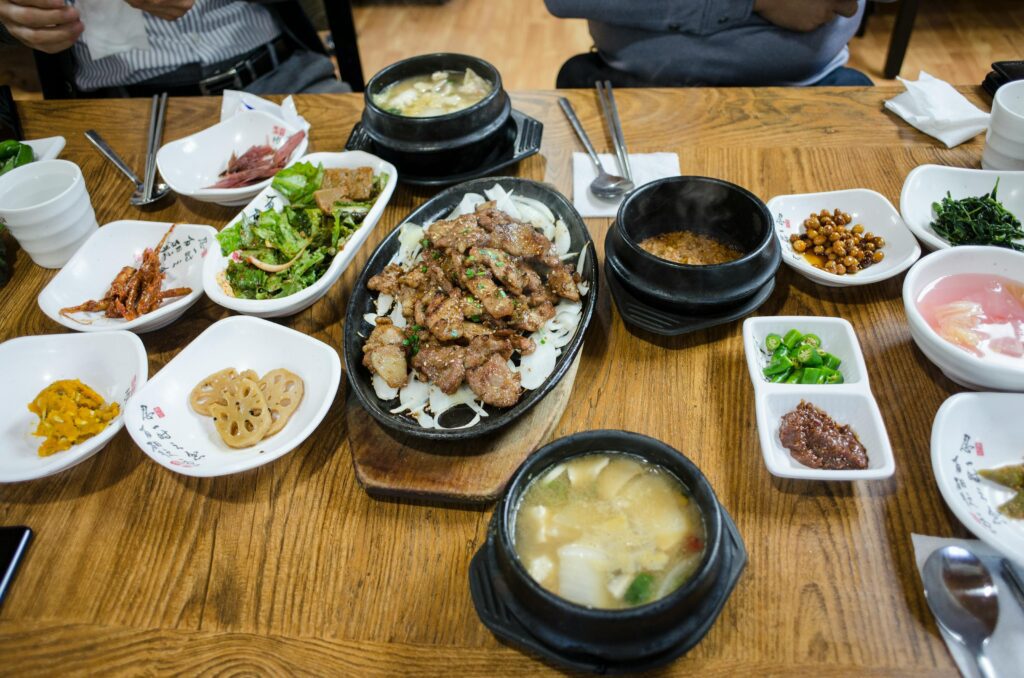
Korean restaurants often display “Self-serve water” signs (source: Go! Go! Hanguk). Under Korean restaurant etiquette, water, cups, banchan refills, and personal plates are usually grouped in one corner.
- A water dispenser, water bottles, paper cups, or stainless cups sit at the self-serve area
- If there’s a separate banchan bar, take an empty plate over and serve yourself
- Personal plates, tissues, and utensils are usually in the table drawer
- If there’s a return counter, drop off your dishes when you’re done
Korean restaurant etiquette: picking solo-dining-friendly places
Solo dining (honbap) is now common in Korea, and reporting suggests more young Koreans actively choose it (source: Korea Joongang Daily). In Korean restaurant etiquette, solo-dining difficulty depends entirely on the restaurant type.
| Difficulty | Restaurant type | Notes |
|---|---|---|
| Easy | Gukbap, haejangguk, seolleongtang, kalguksu, ramyeon, kimbap, deopbap | Built around 1-person sets, fast turnover |
| Easy | Bunsik (snack bars) | Single-portion ordering, small tables |
| Easy | Baekban (1-person set meal) | Rice + soup + banchan as a complete 1-person tray |
| Easy | Franchises (kiosk / solo seats) | Zero ordering pressure, bar-style seating |
| Hard | BBQ houses (samgyeopsal, gopchang) | 2-portion minimum, plates set for two |
| Hard | Gamjatang, budae-jjigae, dak-han-mari, jjim/jeongol | Built around 2~3+ person portions |
Tips that boost solo-dining success rate under Korean restaurant etiquette:
- Look for menu lines that say “1-person portion available” or “honbap welcome”
- If reviews mention “I went alone and it worked”, success odds jump
- For BBQ, search “1-person meat / hongogi”, bar-style seating, or staff-grilled spots
- Avoid peak hours (weekday 12:00~13:00, weekend 18:00~20:00) for an easier solo experience
Korean restaurant etiquette: sharing and family-style dining
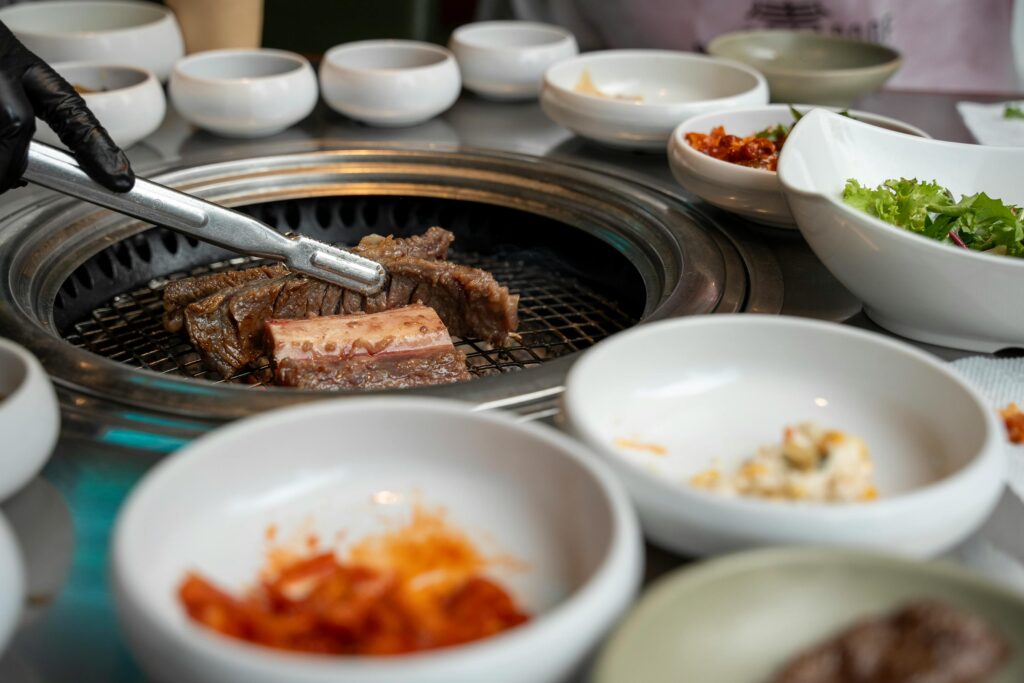
A typical Korean meal puts shared dishes at the center of the table, with banchan also eaten communally (source: MICHELIN Guide). The core sharing rules under Korean restaurant etiquette:
- Don’t dig through shared banchan with your chopsticks looking for the best piece
- Move food to a personal plate (apjeopsi) when possible
- Unless you’re close, don’t stir shared soup or stew with your own spoon
- If there are serving spoons or shared chopsticks, use only those
Hygiene awareness has tightened, so asking for a personal plate is normal. “Apjeopsi juseyo” (“A personal plate, please”) is all you need.
Drinking etiquette: pouring with two hands and refilling someone else’s glass
Drinking sessions are where Korean restaurant etiquette stands out the most. When an elder or a senior pours for you, receive the cup with both hands; when you pour for them, support the bottle’s underside with your other hand (source: Asian Inspirations).
- Wait for the elder or senior to start pouring first, then receive your cup
- Don’t refill your own empty glass — let the person next to you do it
- Receive with two hands; pour with two hands (or one hand + the other supporting your wrist)
- For the first drink, some people slightly turn away from the senior to drink
Korean restaurant etiquette: banchan refills, what’s free vs. what’s not
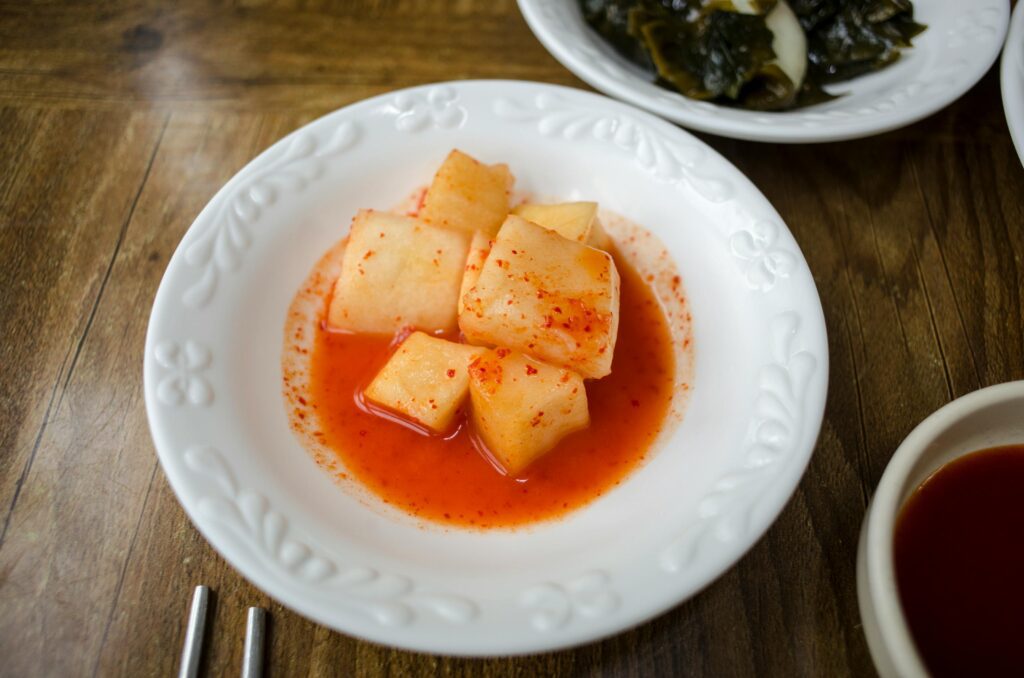
One of the signature features of Korean restaurant etiquette is the banchan (side-dish) service, and many places allow refill requests (source: Taste Korea).
- Banchan jom deo juseyo — Can I have more side dishes?
- Kimchi deo juseyo — More kimchi, please
- Igeo han beon deo juseyo — One more of this, please
Practical refill rules under Korean restaurant etiquette:
- “Standard banchan” usually has free refills
- Premium sides like ganjang-gejang, japchae, or steamed egg may be paid or non-refillable (depends on the shop)
- At a self-serve banchan bar, take only what you’ll actually eat — leftovers feel wasteful
- If a refill takes a while, don’t push — staff are likely handling another table
How to use “Chuga-yo!” for follow-up orders
Adding to your order partway through the meal is completely natural — no need to feel awkward. Press the call bell once, say one phrase, done. Korean restaurant etiquette actually encourages a base order followed by add-ons, especially for parties of 2~3.
| Situation | Korean phrase | English |
|---|---|---|
| Extra rice | Gonggibap chuga-yo | Extra bowl of rice |
| Extra noodles | Sari chuga-yo | Extra noodles / add-on |
| Extra meat | Gogi 1-inbun chuga-yo | One more serving of meat |
| Extra drinks | Soju / Maekju chuga-yo | Another soju / beer |
| More water | Mul jom deo juseyo | More water, please |
Korean restaurant etiquette: paying, tipping, and receipts
Korea generally has no tipping culture, except in rare cases like luxury hotels or high-end tours. Under Korean restaurant etiquette, payment usually follows one of two formats (source: Total Korean).
- Table payment — say “Gyesanseo juseyo” (“Bill, please”) and a server brings the card terminal
- Counter payment — pay at the front counter on your way out (this is the most common)
Splitting the bill (going Dutch):
- Gakja gyesan-halgeyo — We’ll pay separately
- Gachi gyesan-halgeyo — One bill, please
- Yeongsujeung juseyo — Receipt please
- Card doe-nayo? — Do you accept cards? (almost every Korean restaurant takes cards)
Floor seating: how to use shoes-off restaurants
Some hanjeongsik, traditional restaurants, and gukbap shops use floor seating where you remove your shoes at the entrance. Under Korean restaurant etiquette, place your shoes in the rack neatly and wear clean socks if you can.
- Use the shoe rack at the entrance or the edge of the raised floor
- When taking shoes off, line them up tidily with the inside hidden
- Cross-legged sitting or knees folded sideways are both acceptable
- Heavy winter boots are awkward — light shoes make floor seating easier
Korean restaurant etiquette: 5 mistakes foreigners make most often
| Mistake | Why it’s awkward | What to do |
|---|---|---|
| Sticking chopsticks upright in rice | Resembles a memorial-table setup; carries unlucky meaning | Lay them flat next to the bowl |
| Refilling your own glass with elders present | In Korean restaurant etiquette, the person next to you should pour | Wait briefly when your glass is empty |
| Reaching into shared banchan with your own chopsticks | Goes against hygiene norms | Move food to your personal plate first |
| Leaving a tip on the table | Korea has no tipping culture — staff will refuse or feel confused | “Jal meogeotseumnida” (thank you for the meal) is enough |
| Sitting and waiting for staff to come | The bell or “Jeogiyo” call is the right move under Korean restaurant etiquette | Use the bell first, then call out |
Memorize one phrase per situation, solve 90% of meals
| Situation | Korean phrase |
|---|---|
| Call staff | Jeogiyo / call bell |
| Start ordering | Jumun-halgeyo |
| Ask for water | Mul jom juseyo |
| Banchan refill | Banchan jom deo juseyo |
| Add-on order | (menu) chuga-yo |
| Personal plate | Apjeopsi juseyo |
| Split the bill | Gakja gyesan-halgeyo |
| One bill | Gachi gyesan-halgeyo |
| Goodbye phrase | Jal meogeotseumnida |
Call bells, self-serve corners, and shared banchan feel unusual at first, but once they click you stop waiting on service and add-on orders become trivial — the meal often ends up less stressful than back home. Korean restaurant etiquette comes down to three axes: the path, the call, and the share. For market-style payment and tasting etiquette, see the Korean market shopping survival guide.
Korean restaurant etiquette FAQ
Q1. Will people stare if I dine alone in Korea?
Not at gukbap, snack bars, deopbap, ramen, or baekban places — solo dining is fully normal there. Reporting also suggests more young Koreans actively choose it (Korea Joongang Daily).
Q2. Are banchan refills always free?
Standard banchan refills are typically free, but premium items like ganjang-gejang or japchae may cost extra or have no refill. Always defer to the shop’s policy (Taste Korea).
Q3. Is it awkward to add to my order partway through?
Under Korean restaurant etiquette this is completely normal. Order modestly first, then add when you’re short — that’s the standard pattern.
Q4. Do I need to tip at Korean restaurants?
Generally, no — Korea has no tipping culture. The only exceptions are situations like luxury hotels or premium tours (Total Korean).
Q5. What if no one comes to my table?
Press the call bell if there is one. If not, just say “Jeogiyo” out loud (Creatrip).
K-Name Studio: Create your perfect Korean name based on your personality and style.
What’s My K-Beauty Personal Color?
WeBring Service : Provides personalized services to foreigners living in Korea
Exclusive offer: Introducing foreign car rental in Korea, WeBring-SoCar
- Korean Cafe Culture Survival Guide: Seat Saving, Self-Order Flow, Study Cafes (Foreigner Edition)
- Korean Banchan: Unveiling the Heart of Korean Cuisine
- Korea Market Shopping Survival Guide: Tips for Foreigners
Last updated: 23 September 2026
Rules, fees and procedures can change over time. Before an important decision, check the latest guidance from the relevant authority.
WeBring operates its own services for foreign residents in Korea. The following is a promotion for those services.
Living in Korea? You don't have to figure it out alone
Insurance, visas, jobs and hospital interpretation — WeBring supports every step of settling in Korea, in your language.