
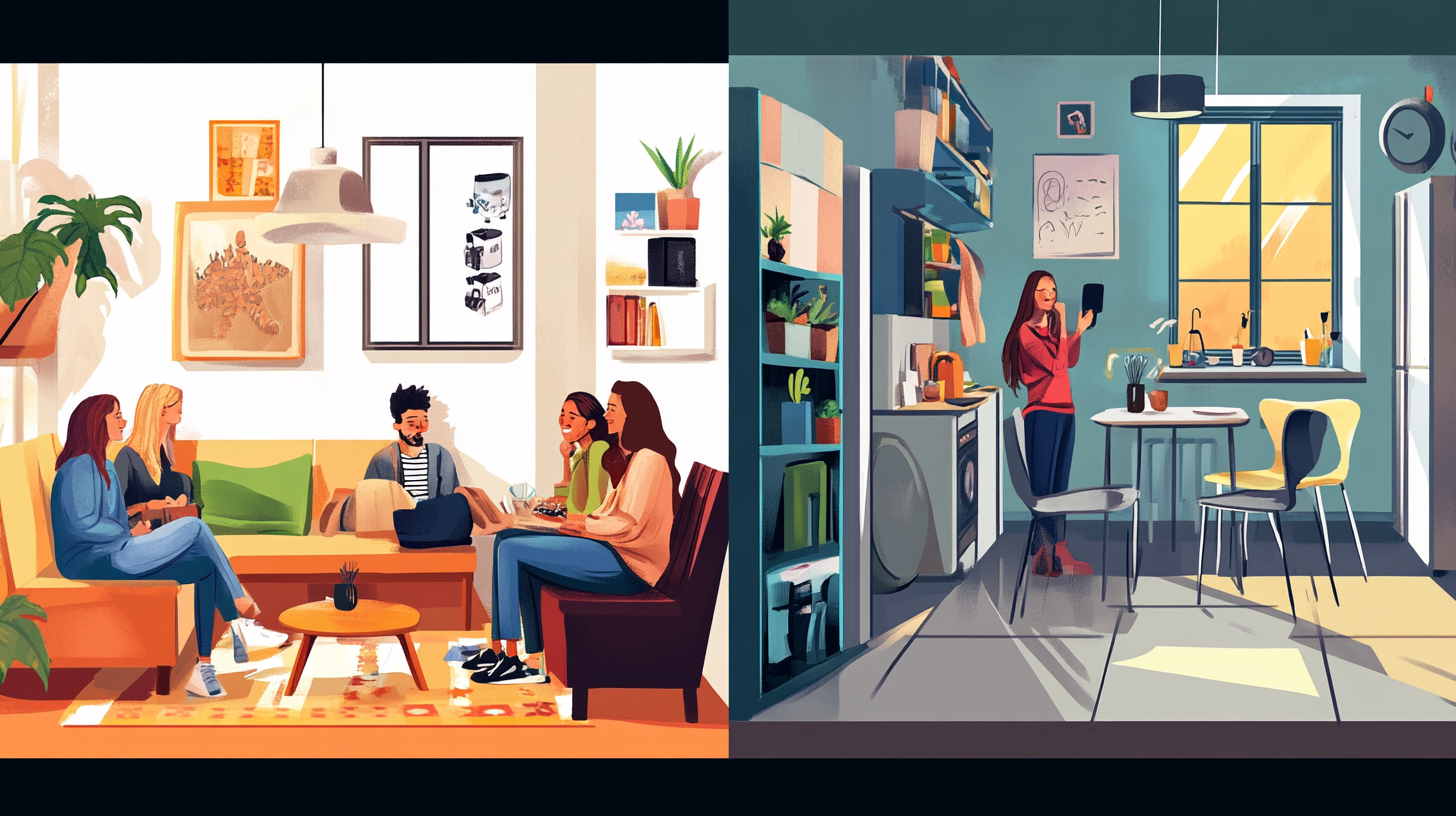

Living in Korea generally comes down to two main choices: renting an individual one-room apartment (원룸) or opting for a share house (쉐어하우스) with other residents. As a foreigner, which option suits you best? Cost considerations, privacy, and opportunities for social interaction all play a role in this decision. In this article, we’ll compare the features, pros, and cons of share houses and one-room apartments, helping you determine the best housing choice for your stay in Korea.
A share house is a communal housing arrangement where multiple tenants live together in a single apartment or house, each having their own private bedroom while sharing common areas such as the living room, kitchen, and bathroom. Unlike dormitories, a share house offers some degree of privacy, but it is not a completely independent living situation. Some share houses are professionally managed by rental companies, while others operate more informally with individuals finding their own roommates.
One of the biggest advantages of a share house is cost efficiency. Since tenants split the rent, utilities, and maintenance fees, individual expenses remain relatively low. For foreigners, this setup also provides a great way to make new friends and adapt quickly to Korean culture. Living with housemates facilitates language exchange, shared meals, and social events, making it easier to build a local support network. If you’re new to Korea, staying in a share house can significantly ease the transition.
Cons: Privacy Concerns & Potential Conflicts
The communal nature of a share house comes with potential downsides, including privacy limitations and conflicts over daily habits. Roommates may have different schedules and levels of cleanliness, leading to disagreements over noise, chores, or shared resources like bathrooms. If a housemate frequently uses the living space late at night or neglects cleanup duties, tensions may arise. It’s important to recognize that most share house conflicts stem from lifestyle differences.
2) One-Room Apartments: Independent Living with Full Privacy
The Basics: Designed for Solo Living
A one-room apartment (원룸) is a compact, self-contained unit that includes a bedroom, kitchen, and bathroom in a single living space. Some one-room units are fully furnished (풀옵션), meaning they come equipped with essentials like a bed, wardrobe, desk, refrigerator, and washing machine, helping tenants avoid extra setup costs.
Foreign residents can find one-room rentals through real estate agents, who will present listings based on budget and location preferences. Rent typically involves a deposit (₩5-20 million) and monthly rent (₩400,000-800,000). Prices are higher in popular areas such as near subway stations, universities, or business districts.

Pros: Full Privacy & Lifestyle Freedom
With a one-room apartment, you enjoy complete independence. There’s no need to worry about noisy roommates or house rules—you can set your own schedule, host guests freely, and maintain your space as you like. Having a private kitchen and bathroom also ensures cleanliness and convenience.
Cons: Higher Costs & Potential Isolation
The price of independence is higher rent and utility costs. Tenants must cover electricity, gas, water, and internet bills on their own, which adds up quickly. Additionally, a one-room apartment doesn’t provide natural opportunities for social interaction, which can lead to feelings of isolation—especially for foreigners who are new to Korea.
3) Comparing Budget, Privacy, and Community Aspects
(1) Budget Considerations
- Share House: Rent ranges from ₩300,000-500,000, depending on the location and room size. Shared utilities reduce costs, and some houses require little or no deposit, making it a budget-friendly choice.
- One-Room Apartment: Typically requires a deposit of ₩5-20 million, with rent around ₩400,000-800,000+. Tenants pay full utility costs, but private amenities offer comfort and convenience.
(2) Privacy & Personal Freedom
- Share House: Reduced privacy due to shared spaces. While private rooms offer some solitude, communal bathrooms can be an inconvenience. However, this option is great for those who enjoy socializing.
- One-Room Apartment: Full independence. Ideal for those who prefer a quiet and self-sufficient lifestyle. However, daily responsibilities (cleaning, repairs) must be managed alone.
- Share House: Encourages social engagement, making it easy to meet both locals and fellow foreigners. It’s an excellent environment for language exchange and cultural adaptation.
- One-Room Apartment: Limited interaction with neighbors. While ideal for focused work or study, forming personal connections may require additional effort.
4) Key Factors for Foreigners When Choosing a Housing Option
Length of Stay
- Short-term (less than 6 months): A share house is often more practical. Flexible contracts and lower deposits minimize financial commitment.
- Long-term (1 year or more): A one-room apartment provides a stable and independent living space, making it a preferable option for extended stays.
Student vs. Working Professional
- Students: A share house near university areas fosters an active social life and study-friendly environment.
- Working professionals: A one-room apartment may be better for workers with irregular schedules or long office hours.
Personality & Preferences
- If you enjoy being around people and want to fully experience local culture, a share house is a great fit.
- If you value peace and independence, or pursue hobbies that could disturb roommates (e.g., gaming, playing instruments), a one-room apartment is better.
5) How to Decide
Neither option is simply better. The answer turns on how long you are staying, how much cash you have up front, and how much time alone you need. Run your own situation through the four rows below and the choice usually settles itself.
| Criterion | Share house wins | One-room wins |
|---|---|---|
| Length of stay | A year or less — exchange programs, language study | Two years or more — employment, settling in |
| Up-front cash | Deposits commonly in the ₩500,000–₩2 million range | Deposits commonly in the ₩5–10 million range |
| Monthly costs | Rent often bundles utilities and internet | Maintenance fees and utilities billed separately on top of rent |
| How you live | You want to meet people and pick up local knowledge | You work late or genuinely need time alone to recover |
Check Before You Sign
- Share house — Ask for two numbers: how many bathrooms, and how many residents. Morning congestion is decided by that ratio, not by the photos. Check whether cleaning rotas and quiet hours exist in writing.
- One-room — If it is advertised as fully furnished, put the age of the appliances and who pays for repairs into the special terms. Spell out what the maintenance fee covers (water, internet, cleaning) in the contract itself.
- Both — Confirm you can file a move-in report (전입신고) and get a fixed date (확정일자) at that address. It is the minimum protection for your deposit, and a contract that blocks it is worth walking away from however cheap it looks.
The deposit gap looks dramatic, but share-house rent frequently includes utilities, so the monthly difference is narrower than the headline figures suggest. A one-room costs more up front and gives you no constraints for the length of the lease. Rather than comparing total cost, separate up-front cash from monthly outgoings and compare each.
Conclusion: Finding the Best Housing Option for Your Lifestyle
When choosing between a share house and a one-room apartment, consider your budget, privacy needs, personality, and length of stay.
- A share house is budget-friendly and great for meeting new people but comes with privacy limitations and potential conflicts.
- A one-room offers full independence and comfort but can be costly and isolating.
If you’re uncertain, a good strategy is to spend the first 6 months in a share house to adjust to life in Korea, then move to a one-room once you’re financially stable and socially established.
Whichever option you choose, thoroughly review the rental contract, deposit terms, and additional costs to ensure a smooth and enjoyable stay in Korea! 🚪🏡
K-Name Studio: Create your perfect Korean name based on your personality and style.
What’s My K-Beauty Personal Color?
WeBring Service : Provides personalized services to foreigners living in Korea
Exclusive offer: Introducing foreign car rental in Korea, WeBring-SoCar
- Share House Guide: Affordable Living, Benefits, Contracts, and Top Platforms
- Foreigner housing, a guide to housing options for your stay in South Korea
- Your Complete Guide to international student housing Korea Costs Lifestyle & Risks
- Dorm vs Self-Boarding for International Students in Korea: A Complete Housing Guide
- Long-term Airbnb stays for foreigners in South Korea: tips for discounts and how to stay conflict-free
Last updated: 7 October 2026
Rules, fees and procedures can change over time. Before an important decision, check the latest guidance from the relevant authority.
WeBring operates its own services for foreign residents in Korea. The following is a promotion for those services.
Living in Korea? You don't have to figure it out alone
Insurance, visas, jobs and hospital interpretation — WeBring supports every step of settling in Korea, in your language.


