
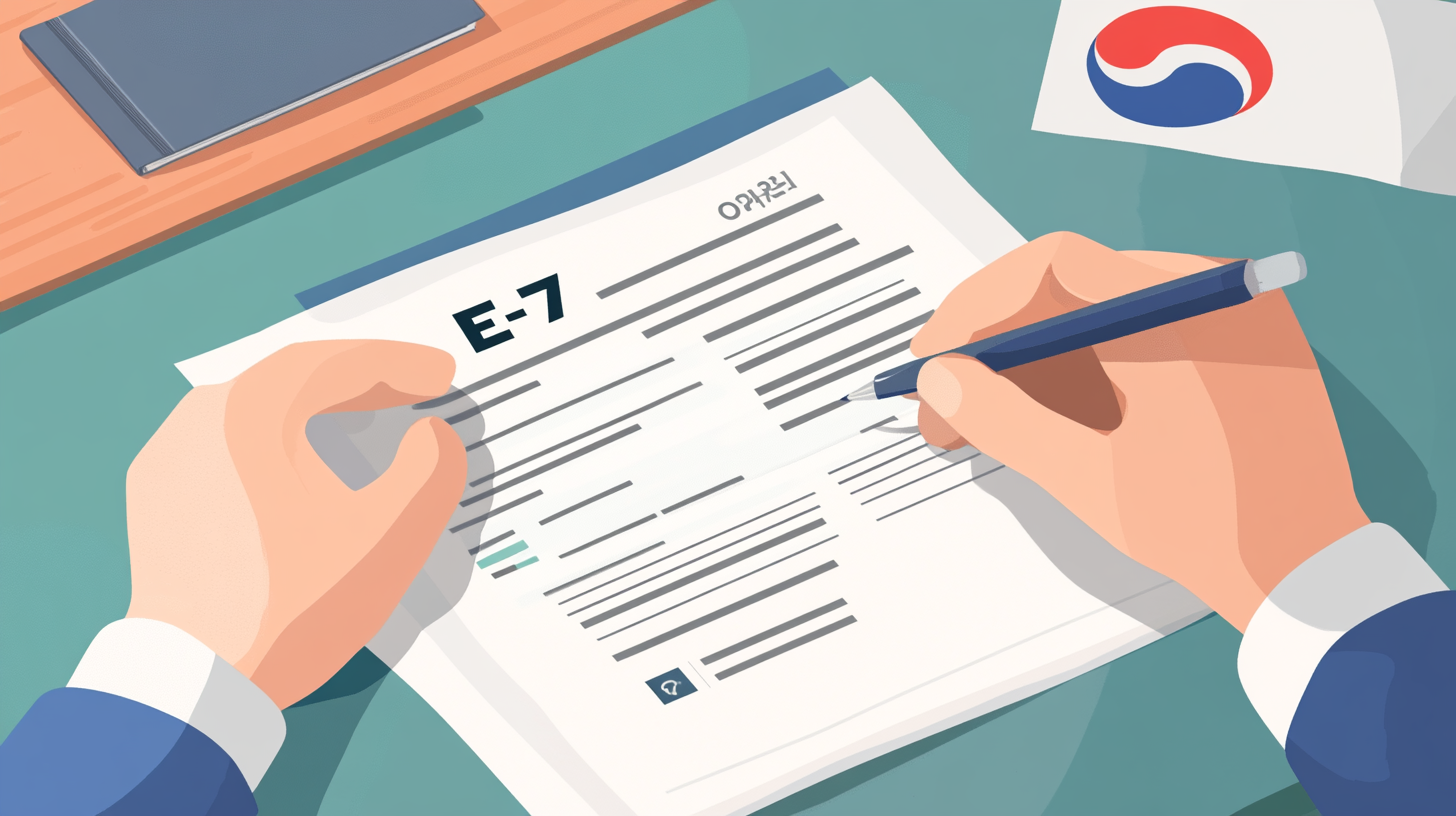

To work in Korea as a foreigner, you need a working visa—primarily categorized as professional (E-7) or field-specific (E-1 to E-6). Among them, the E-7 is the most widely used due to its broad qualifying job categories. However, the application process is complicated, with many documents to submit. If not properly prepared, you risk a rejection. In this post, we’ll walk you through the E-7 visa requirements, required documents, and employer sponsorship procedures to help you prepare successfully.
1) What is the E-7 Visa?
Covers a Wide Range of Professional & Technical Jobs
The E-7 (Specific Activities) visa is a professional work visa for foreigners hired by Korean companies. It covers a wide range of occupations, including researchers, engineers, designers, chefs, translators, and more (as outlined by the Ministry of Justice). Jobs that don’t fall under other categories like E-1 (Professor) or E-2 (English Teacher) generally default to E-7. In short, if a foreigner plans to work in Korea for pay, the E-7 visa is often the appropriate choice.
Company Acts as Sponsor (Employer Role)
To get an E-7 visa, a Korean company must act as the applicant’s “sponsor.” The company must justify to the immigration office why this foreign national is necessary for the position and prove that the job requires specialist skills. They also need to submit documents like an employment contract and their financial statements to demonstrate stable employment conditions. Since individuals may find it difficult to compile everything on their own, cooperation with the HR department or a licensed immigration expert is essential.

2) Eligibility Requirements: Education, Experience & Salary
Educational Background
A bachelor’s degree or higher is generally favorable. However, for certain technical or vocational positions, an associate’s degree, a national license, or substantial work experience may qualify. The exact requirements vary by field. Therefore, the applicant may need to submit either a diploma from an accredited university (domestic or international) or a combination of a vocational license and work history. For instance, chefs may qualify without a degree if they hold a national culinary certificate and have several years of experience.
Work Experience & Salary
One of the crucial factors in E-7 screening is the applicant’s annual salary. The offered salary must exceed a minimum set by the government each year (e.g., approximately 23–24 million KRW in 2023). This aims to prevent foreign workers from being underpaid compared to Korean employees. Immigration officers will also assess whether the applicant has sufficient experience for the position, or, if a newcomer, whether their degree is relevant to the field.
Additional Industry Restrictions
Some fields—such as engineering, design, IT, culinary arts, and culture—may require point-based evaluations, licenses, or extra proof. For example, chefs usually need a national culinary certification from their home country and at least five years of experience. The company must also explain why it is difficult to fill the position with a Korean candidate.
3) Required Documents: From Both Company and Applicant
Employer Documents
- Copy of Business Registration Certificate
- Signed Employment Contract (including salary and conditions)
- Company Introduction & Overview (scale, financial status, number of employees, etc.)
- Statement of Reasons for Hiring a Foreigner
- National Insurance Registration Certificate (to prove employee status)
Applicant Documents
- Passport and Passport-sized Photo
- Diploma or Qualified License (original or apostilled copy)
- Certificate of Career/Work Experience (relevant to the job)
- Criminal Background Check (for select fields)
- Health Examination Report (if applicable)
- Resume (in Korean or English)
Additional documents may be required depending on the applicant’s nationality and job type. For example, translated and notarized copies of original certificates might be needed. Some companies may work with immigration lawyers or administrative experts to collect and submit everything on behalf of the applicant.
4) Application Process: Step-by-Step
1) Job Offer Confirmation
First, the foreign applicant must secure a confirmed job offer from a Korean company. Once verbal or written agreement is reached via email or contract, the company must formally agree to sponsor the E-7 visa. If the company has no prior experience hiring foreigners, mutual coordination is crucial for navigating immigration procedures.
2) Visa Issuance Approval Number (CoE) Application
The employer submits an application for a “Visa Issuance Approval Number” at the local immigration office. This includes both company and applicant documents. The review process typically takes 2 to 4 weeks. Once approved, the number (also known as a Confirmation of Visa Issuance, or CoE) is issued.
3) Embassy Visa Application (Outside Korea)
The applicant brings their CoE to a Korean embassy or consulate in their home country (or country of residence) to apply for the E-7 visa. Required items include the CoE, passport, photo, and application fee. The visa is usually issued within 1 to 2 weeks. If the applicant is already in Korea (e.g., on a student D-2 visa), they can apply to change their visa status to E-7 within the country.
4) Alien Registration After Entry
Once entering Korea with the E-7 visa, the applicant must apply for an Alien Registration Card (ARC) within 90 days. This requires visiting the immigration office to register biometric data and residential address. Once registered, the applicant can officially begin working and receive salary per the signed contract.
5) Additional Notes: Visa Renewal, Job Change & Risks
Visa Renewal (Extension)
E-7 visas are usually granted for 1 or 2 years, depending on the case. If the company wishes to continue employing the person and the person has worked responsibly, they can apply for an extension through the same screening process. Authorities may reassess the company’s financial status and the foreign worker’s performance at this time.
Changing Jobs (Transfer of Sponsorship)
If the applicant wants to move to another company in Korea while on an E-7 visa, they must apply for a change in visa sponsorship. The new company must act as the sponsor, and approval must be granted before the applicant can begin working. Failing to follow procedure can result in illegal employment status.
Reasons for Visa Cancellation
The E-7 visa can be revoked if the company shuts down, the employee leaves the company without notice, or if it’s revealed that false documents were submitted. Crimes or overstaying one’s visa period may also result in cancellation. Any major change in employment status must be reported to immigration immediately.
Bonus: Overview of E-1 to E-6 Visa Types
In addition to the E-7 visa, Korea offers various job-specific visas:
- E-1 (Professor): For university-level professors and researchers.
- E-2 (Foreign Language Instructor): For teaching English or other foreign languages.
- E-3 (Research): For researchers in accredited institutions.
- E-4 (Technological Guidance): For technical advisory roles.
- E-5 (Professional): For licensed professionals like doctors, lawyers, etc.
- E-6 (Arts & Culture): For work in the arts, performance, or sports industries.
Each has clearly defined occupational boundaries. If none apply, E-7 is the general alternative.
Conclusion: Preparation & Employer Collaboration Are Key
Obtaining an E-7 or other work visa involves joint efforts from both employer and job applicant. Meeting eligibility criteria (education, experience, salary) and correctly submitting documents (employment contract, financial data, degree certificates, etc.) are essential to pass immigration screening. Though the process may feel challenging, following the steps carefully allows you to legally work and build your career in Korea.
Depending on your nationality and job sector, preparation needs will vary. For instance, a non-IT professional may have to emphasize technical certifications or experience, while those aiming for trading companies may need to prove their language skills. If the employer has never sponsored a foreign employee, hiring an administrative consultant may be helpful.
Ultimately, with South Korea’s growing global presence, the demand for foreign professionals continues to rise. If you’ve reviewed the process and paperwork clearly in this guide, your next step is to finalize sponsorship during your job search. With proper preparation and employer collaboration, building a career in Korea will be within reach.
Occupation Codes: E-7 Is Not One Visa
Understanding E-7 review starts with this structure. E-7 is permitted only within a list of occupations designated by the Ministry of Justice, and the requirements differ by occupation. Approaching it as “this is a professional job, so it should qualify” is the wrong model.
- Whether the occupation is on the list is the first gate. Work not on it does not go through E-7, however specialized it is.
- Requirements vary by occupation — some call for a degree, some for experience, some for a certification.
- The list and its requirements are revised. Guidance changes annually, so check current standards at Hi Korea; a case from two years ago is no guarantee now.
- Actual duties are the test. Assessment follows the work, not the job title, so the job description must match the listed occupation.
Education and experience are often substitutable for one another — a related degree reduces the experience required, and without a degree a longer track record is expected. Working out which combination satisfies the requirement before you apply makes the document list obvious.
Employer-Side Requirements: When the Company Cannot Sponsor
A perfect personal file still fails if the company does not qualify. These are the things to check when you receive an offer.
- Ratio of foreign to Korean employees — there are limits on how many foreign nationals can be employed relative to domestic staff. Small companies hit this most often.
- Financial standing and trading history — newly formed entities or companies without verifiable revenue struggle to qualify as sponsors.
- Past employment record — previous violations involving foreign workers can bring restrictions.
- Salary level — occupations carry expected wage standards, and a contract below the threshold is refused.
This makes whether the company has hired foreign nationals before genuinely important. Where they have not, HR frequently does not know what to prepare, so checking the document list yourself and passing it over is faster. Even when the company says they will handle it, verify the progress directly.
When the Visa Is Cancelled or an Extension Blocked
E-7 is bound to employment, so when the job moves, your status moves with it. Knowing this in advance is what makes a response possible.
| Situation | Effect | What to do |
|---|---|---|
| Resignation or dismissal | Purpose of stay ends; you must find a new workplace or change status within a set period | Report immediately and act within the remaining window |
| Company closure | The same, even though it is not your fault | Secure documentation of the closure |
| Actual duties differ from what was approved | Can be grounds for cancellation | If duties change after joining, check what procedure applies |
| Salary differs from what was declared | A problem at extension review | Keep payslips and the contract |
If you leave a job, the first thing to do is report it to immigration and establish how long you have. Where a search period is needed, changing to D-10 is a route — and that too has to be applied for within the window. Doing nothing removes the options: in this situation, inaction is the worst response available.
K-Name Studio: Create your perfect Korean name based on your personality and style.
What’s My K-Beauty Personal Color?
WeBring Service : Provides personalized services to foreigners living in Korea
Exclusive offer: Introducing foreign car rental in Korea, WeBring-SoCar
- Work Visa Change: Key Considerations for Foreign Nationals in Korea
- Foreigner Job Search Korea: Your Ultimate Guide
- Foreign Professionals in Korea: Licensing and Opportunities
- Master the Teach English Korea E-2 Visa Process Your Ultimate Handbook
- Certification for Foreigners in Korea: A Comprehensive Guide
Last updated: 23 September 2026
Immigration rules and guidelines change often. This article summarises information that was publicly available when it was written and is not legal advice for your individual case. Confirm the current requirements with HiKorea (1345) or your local immigration office before you apply.
WeBring operates its own visa application and extension service. The following is a promotion for that service.
Don't let your visa expire
Check your remaining stay and extension deadline in 30 seconds with the WeBring visa calculator. Need help with the paperwork? Our experts speak your language.