
The Gyeongju ancient history museum sites one-day course is the fastest way to grasp a thousand years of Silla. You anchor the context inside the museum, walk through the royal palace ground, see the observatory and royal tombs, and then close the loop with a night view — all walkable, all bike-friendly, all reachable by city bus. Every key district sits inside the UNESCO Gyeongju Historic Areas, packed densely enough that no car is required.
This guide is written so a foreign visitor can walk it without getting lost. The Gyeongju Historic Areas are made up of five districts (Namsan, Wolseong, Daereungwon, Hwangnyongsa, Sanseong). The day course centers on Wolseong and Daereungwon, adds one museum and one night-view stop, and ties them into a single five-point loop.
Gyeongju Ancient History Museum Sites at a Glance
The route and budget come first. The recommended base loop runs Gyeongju National Museum → Wolseong → Cheomseongdae → Daereungwon (Cheonmachong) → Donggung & Wolji night view. Walking and bike segments connect every stop, and the minimum entrance fee per adult is KRW 6,000 (Cheonmachong 3,000 + Donggung & Wolji 3,000).
| Time | Place | Fee | Hours |
|---|---|---|---|
| 10:00–12:00 | Gyeongju National Museum | Free | 10:00–18:00 (Sat 20:00 Mar–Oct) |
| 13:00–14:00 | Wolseong (Banwolseong) | Free | No limit |
| 14:10–14:40 | Cheomseongdae | Free | 09:00–22:00 (winter 21:00) |
| 15:00–17:00 | Daereungwon · Cheonmachong | Cheonmachong KRW 3,000 | 09:00–22:00 (last entry 21:30) |
| 19:00–21:30 | Donggung & Wolji (night view) | KRW 3,000 | 09:00–22:00 (last entry 21:30) |
Lunch fits naturally on Hwangnidan-gil near Daereungwon, where hanok cafes and local restaurants sit within a 5-minute walk and a meal wraps up in 30 minutes. Dinner can go either right before or right after the Donggung & Wolji visit, again from Hwangnidan-gil.
Gyeongju National Museum — Context From 100,000 Silla Artifacts

Gyeongju National Museum is the best starting point for any Silla history walk. The permanent galleries split into three halls (Silla History, Silla Art, and Wolji Hall), and the collection runs to roughly 100,000 items. Rather than wandering the route in order, start in the Silla History Hall to lock in the chronology up to unification, then circle the other halls — that order saves time and improves comprehension.
The Silla Art Hall centers on golden crowns and belt ornaments. Crowns excavated from Geumgwanchong, Seobongchong, and Cheonmachong sit side by side, and comparing the small differences in the openwork details alone takes 30 minutes. The Wolji Hall holds wooden tablets, roof tiles, and household items dug up from Donggung (Anapji) under Unified Silla, which makes it a useful preview for the night view at Donggung & Wolji later in the day.
Plan two hours for the museum, but do not skip the Sacred Bell of King Seongdeok (the Emille Bell) housed in the outdoor pavilion just before the exit. At 3.75 meters tall and roughly 18.9 tons, it is the largest extant Korean temple bell. The official museum app offers English and Japanese audio guides, which helps when traveling with companions who do not read Korean.
- Hours: 10:00–18:00 / Sat 20:00 (Mar–Oct)
- Closed: Jan 1, Lunar New Year, Chuseok
- Fee: Free permanent exhibition
- Transit: City bus 11 or a 10-minute bike ride to Wolseong
For up-to-date hours and notices, the Korea Tourism Organization site is reliable. For background on the heritage zone overall, the UNESCO listing is a good reference.
Wolseong & Cheomseongdae — Walking the Silla Royal Ground
Wolseong (Banwolseong) sits a 10-minute walk from the museum. It is the site of the Silla royal palace, and parts of the wall and moat have been restored. Excavations underway since 2017 have surfaced human and horse bones tied to ritual sacrifice, drawing strong academic attention. You can view the dig from designated trails, and the on-site signage outlines the progress.
Visit the permitted areas of Wolseong free of charge. Gyeongju’s 2026 guide describes Wolseong-irang as an advance-booking program; check sessions for your date. Stay outside restricted excavation areas.
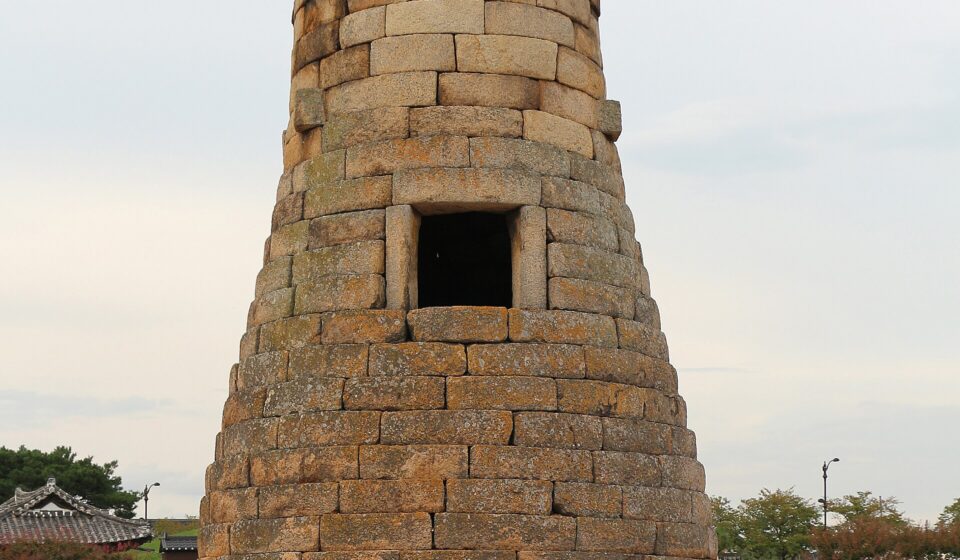
From Wolseong, a 5-minute walk north brings you to Cheomseongdae. Built in the 7th century during Queen Seondeok’s reign, Cheomseongdae is regarded as the oldest surviving astronomical observatory in East Asia. The cylindrical structure stacks 362 granite stones to a height of about 9.1 meters, and the surrounding lawn plaza is wide enough that the photo background stays clean.
- Wolseong: Free / 24h open / Wolseong-irang: reserve an available session
- Cheomseongdae: Free / 09:00–22:00 (winter 21:00)
- Transit: Museum → Wolseong 10 min walk → Cheomseongdae 5 min walk
Daereungwon & Cheonmachong — 23 Silla Royal Tombs in One Park

From Cheomseongdae, a 10-minute walk northwest leads to the Daereungwon entrance. Daereungwon is a tomb park gathering 23 mounded tombs of Silla kings and aristocrats, with one excavated tomb (Cheonmachong) you can actually walk inside. Cheonmachong displays replicas of the gold crown, “Cheonmado” (heavenly horse painting), and glass cup unearthed in the 1973 dig, with the burial chamber section reproduced as it was — the scale of a Silla royal tomb hits you in person.
The walk itself is the highlight. Curving mounds and pine trees frame photos at any hour, though early morning and golden hour give the softest light. Daereungwon stays open until 22:00, so a night stroll among the tombs is possible too.
- Daereungwon: 09:00–22:00 (last entry 21:30) / Free
- Cheonmachong: Adult KRW 3,000 / Youth 2,000 / Child 1,000
- Parking: Daereungwon public lot (small fee)
If you stay overnight, the next-day plan can extend into the Gyeongju 1-night-2-days Bulguksa course to add Silla Buddhist heritage. Comparing era-by-era heritage routes across Korea? The modern history sites course is a useful counterpart.
Donggung & Wolji (Anapji) Night View — Closing the Loop
Donggung & Wolji is the site of a Unified Silla detached palace and pond used by the crown prince. It was widely known as Anapji until 2011, when an inscription on excavated artifacts confirmed Donggung & Wolji as the historical name. Three buildings (Imhaejeon among them) have been restored around the pond, and once the lights come on after sunset the reflection on the water spreads into the most photographed night view in Gyeongju.
Aim to enter about 30 minutes before sunset. The window where afterglow and lighting overlap is the prime photo time. The northern walkway and the southern deck are the two main viewpoints; the north angle captures the buildings and the water reflection together. Plan 40 to 60 minutes inside.
Donggung and Wolji closes at 22:00, with ticket sales ending at 21:30. Allow for queues and viewing time. Daereungwon grounds are free, while Cheonmachong and Donggung and Wolji charge separate admission. Compare any pass against its current covered sites and price.
- Hours: 09:00–22:00 (last entry 21:30)
- Fee: Adult KRW 3,000 / Youth 2,000 / Child 1,000
- Parking: Free
- Note: 30+ minute queue possible on weekend nights
Optional — Hwangnyongsa History Hall and Extending the Course
Hwangnyongsa History and Culture Hall is announced closed July 1–November 20, 2026 for renovation, including exhibitions, screening rooms and café. Omit the indoor visit during this period and confirm reopening afterward. Follow local access restrictions at the outdoor temple site.
- Hours: 09:00–18:00 (Apr–Oct weekends and holidays until 19:00)
- Closed: Jan 1, Lunar New Year, Chuseok
- Fee: Adult KRW 3,000 / Youth 2,000 / Child 1,000 (city listing; confirm after reopening)
To go deeper into Gyeongju ancient history, add a second day for Bulguksa and Seokguram (UNESCO World Heritage). They are in the Mount Toham area, which is a separate route from the in-town circuit, so it is more efficient to plan a fresh day. If a single day is genuinely tight, trim time between Cheomseongdae and Wolseong and reallocate the saved minutes to the museum, Daereungwon, or Donggung & Wolji.
Practical Tips for the Gyeongju Ancient History Museum Sites Course
Bike rentals are the most efficient transport in central Gyeongju. Public bike stations sit near the museum and around Hwangnidan-gil at roughly KRW 1,000–2,000 per hour. By public transit, check the connection from KTX Gyeongju Station to downtown separately. Bus 10 does not depart directly from that KTX station. Weekends bring heavy car traffic, so transit often beats driving.
Plan around the seasons too. March–May (cherry blossoms) and September–November (autumn foliage) drive a sharp surge in visitors, with full parking lots and longer waits on Hwangnidan-gil. July–August opens the lawn around the tombs to harsh direct sun, so early morning or late afternoon is more comfortable. Winter is quietest, and because sunset is early, Donggung & Wolji takes on its night-view mood from 17:30 onward.
For lodging, hanok guesthouses around Hwangnidan-gil are the safest pick. Cheomseongdae and Daereungwon stay walkable, which makes a quiet early-morning tomb walk possible the next day. Empty Daereungwon at sunrise — dewy grass and the curve of the mounds — looks completely different from the daytime. To compare other heritage routes in Korea, the traditional market and history street guide pairs well with this course.
Frequently Asked Questions
- Do I need a car for the Gyeongju day course?
- No. The museum, Wolseong, Cheomseongdae, Daereungwon, and Donggung & Wolji are all linked by walking or bike. City buses 10 and 11 also connect every major site on a single line.
- Are there foreign-language guides?
- The Gyeongju National Museum app provides English and Japanese audio. Signs at Donggung & Wolji and Daereungwon are in Korean, English, Chinese, and Japanese.
- What is the fastest way to buy tickets?
- Daereungwon, Donggung & Wolji, and Cheonmachong all sell tickets at the on-site booth. Donggung and Wolji ticket sales end at 21:30, so entering before 21:00 is the safer cutoff for the night view.
- Can I add Hwangnyongsa History Hall the same day?
- Yes. It is a 10-minute walk from Donggung & Wolji, so slotting it around 17:00 before the night view works. Just remember it closes at 18:00.
Image credits
- Featured: Bernard Gagnon / Wikimedia Commons (CC0)
- Gyeongju National Museum: Seaton1456 / Wikimedia Commons (CC BY-SA 3.0)
- Daereungwon: Bernard Gagnon / Wikimedia Commons (CC0)
- Donggung & Wolji: stari4ek / Wikimedia Commons (CC BY-SA 2.0)
K-Name Studio: Create your perfect Korean name based on your personality and style.
What’s My K-Beauty Personal Color?
WeBring Service : Provides personalized services to foreigners living in Korea
Exclusive offer: Introducing foreign car rental in Korea, WeBring-SoCar
The museum closes January 1, Seollal and Chuseok; exhibition rooms also close on the second Monday of March, June, September and December.
Operating information checked September 8, 2026: 1, 2, 3, 4
Additional operating checks, September 8, 2026: Hall closure · Wolseong booking
- Gyeongju Donggung Wolji Night View Course: Silla Moonlit Guide
- Gyeongju Bicycle Travel Route: 6.5km Loop Through Daereungwon, Cheomseongdae & Woljeonggyo
- Gyeongju Historical Tour: Explore Silla’s Ancient Capital
- Gyeongju 1 Night 2 Days Bulguksa Course: Seokguram, Daereungwon, Hwangnidan-gil
Last updated: 22 September 2026
Prices, opening hours and transport schedules change with the season and the operator. Check the official channel again before you go.
WeBring operates its own Korea tour and vehicle services. The following is a promotion for that service.
Explore Korea's mountains — guides in your language
Courses, transport and seasonal tips for 30 mountains, from Bukhansan to Hallasan, available in 11 languages. Pick up essential travel Korean and find events for the global community, too.