
The Pohang Jukdo Market food route is the most efficient way to enjoy gomtang, sashimi, mulhoe, octopus, and gwamegi in one go at the East Coast’s largest traditional market. With 1,500+ stalls connecting fish market, food alleys, and dried-goods alleys into a single block, first-time visitors easily lose their bearings. This guide covers both a 2-3 hour core course and a 4-6 hour full course, with foreigner ordering phrases, public parking fees, and the sashimi center seating-fee system, so you finish your food trip without backtracking.
Pohang Jukdo Market food route core information
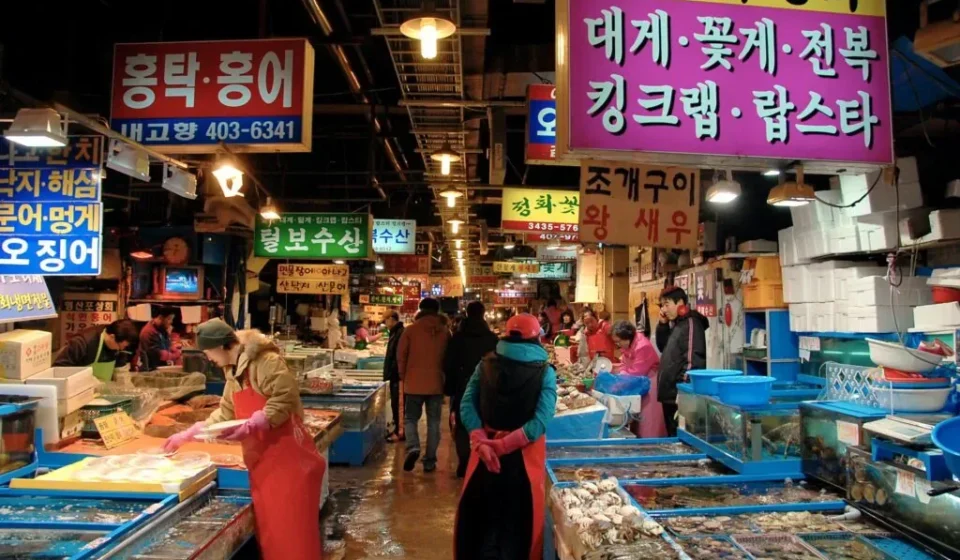
Jukdo Market sits in Jukdo-dong, Buk-gu, Pohang City, Gyeongbuk Province — the largest traditional market on Korea’s East Coast. About 200 sashimi houses cluster in the fish market, plus gomtang, sujebi, octopus, and dried-goods alleys all within a 5-minute walk, making it ideal for a single-meal course. Operating details are confirmed at Korea Tourism Organization.
| Item | Detail |
|---|---|
| Address | 13 Jukdosijang 13-gil, Buk-gu, Pohang-si, Gyeongsangbuk-do (Jukdo-dong) |
| Phone | 054-247-3776 |
| Hours | 08:00–22:00 (varies by stall) |
| Closures | Open year-round (individual stalls may close) |
| Parking | Public Lots #1–#5 (paid) |
| Parking fee | First 20 min KRW 500, then KRW 200/10 min, daily max KRW 7,000 |
| Lot hours | Lots 1·2·3 07:00–22:00, Lot 4 06:00–22:00 |
Pohang Jukdo Market food route at a glance
The Pohang Jukdo Market food route splits into two formats by available time. If you’re short on time, take the 2-3 hour core route; with more flexibility, the 4-6 hour full route is recommended. Both warm up the stomach with hot soup (gomtang or sujebi) before moving to sashimi, mulhoe, and octopus.
| Course | Duration | Sequence |
|---|---|---|
| Core 2–3 h | 2–3h | Gomtang/sujebi alley → fish market sashimi center → octopus alley taste → dried-goods shopping |
| Full 4–6 h | 4–6h | Gomtang/sujebi → fish market (live & fresh fish + sashimi) → Pohang mulhoe → octopus alley → snow crab/red crab (optional) → gwamegi & dried goods → rice cake alley |
After the market, consider Yeongildae Beach as a separate stop. Ganjeolgot is in Ulsan, so it cannot be added as a local walk from Jukdo Market. Plan intercity transport if combining the two.
Pohang Jukdo Market food route step-by-step detail
The 8 steps below assume the 4-6 hour full course. For the core course only, picking 1, 3, 5, and 7 is enough. Heavy items like sashimi or crab are best finished in one place per group of two before moving to another alley.
- Warm-up (gomtang or sujebi alley) — Especially with foreign companions or kids, start with hot soup before sashimi or mulhoe.
- Fish market sashimi center — 200+ sashimi houses in Jukdo Fish Market. The standard format: buy live fish on the 1F, then go up to 2F and pay a seating fee for cutting service, banchan, and tableware. Useful orders: “What’s recommended in season?”, “How much is right for two?”
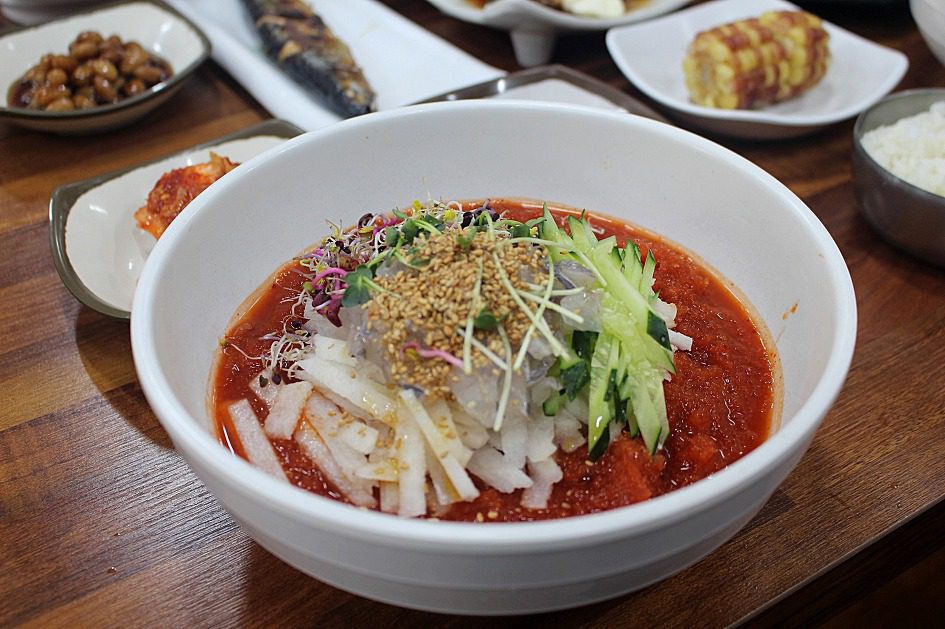
- Pohang mulhoe — Pohang’s chilled raw-fish soup is famous nationwide. Easy to enjoy even for sashimi beginners and you can ask “make it less spicy.”
- Octopus alley — Inside the fish market. Order steamed octopus or boiled octopus; the visual presentation is half the fun.
- Snow crab / red crab (optional) — Confirm “today’s market price” first. Two diners are often satisfied with sashimi + mulhoe alone, so add crab only if appetite allows.
- Gwamegi & dried goods — Dried-goods alley year-round; gwamegi (semi-dried Pacific saury) in winter. Parcel shipping is available from the market. Souvenir picks: anchovies, seaweed, kelp, dried squid, pollack jerky, and gwamegi in season.
- Parking (Public Lots #1–#5) — Centrally numbered lots near the market. Daily max KRW 7,000 keeps it affordable.
- Rice cake alley finish — A sweet ending wraps up the course cleanly.
Pohang Jukdo Market food route sashimi center seating-fee system
The seating-fee (jaribi or sangcharimbi) system at the Jukdo sashimi center can be confusing on a first visit. One format: pick the live fish on 1F and have it cut on the spot. Another: buy fish from a stall and go up to 2F, paying a seating fee that covers chogochujang sauce, spicy stew, side dishes, and tableware. Seating fees usually run KRW 5,000–10,000 per person; drinks and soju are billed separately. Some middlemen run direct stalls with slightly different pricing structures.
- 1F purchase + 2F seating fee: Live fish prices fluctuate daily. Confirm if the seating fee includes spicy stew, banchan, and tableware.
- Direct sashimi houses: No seating fee, fixed menu prices. Portions are set, so order based on group size.
- Per-kilogram pricing: Many stalls quote prices per kilogram. “How much per kilogram?” is the first question to ask.
Pohang Jukdo Market food route Korean phrases for foreigners
These phrases help with price, cooking and takeaway questions. Confirm the seller understood the quantity and total price; a short phrase list does not guarantee smooth communication in every shop.

| Situation | Korean phrase | Meaning |
|---|---|---|
| Price check | Kg-dang eolma-yeyo? (kg당 얼마예요?) | How much per kilogram? |
| Sashimi order | Hoe tteo-juseyo (회 떠주세요) | Please slice the fish into sashimi. |
| Spice level | Deol maepge haejuseyo (덜 맵게 해주세요) | Make it less spicy. |
| Cooking | Jjeo-juseyo (쪄주세요) | Please steam it. |
| Takeaway | Pojang-hae juseyo (포장해 주세요) | Please pack it to go. |
| Parcel | Taekbae-ro bonaejuseyo (택배로 보내주세요) | Please ship it by parcel. |
Pohang Jukdo Market food route nearby itinerary pairing
Yeongildae Beach and Hwanho Park can be separate stops after Jukdo Market. They are not all a 10–20-minute walk from the market. Check an actual walking or driving route and allow additional uphill walking inside Hwanho Park. Homigot and Ganjeolgot require separate transport planning.
- Yeongildae Beach night stroll — 10 minutes by car from Jukdo Market. Routing details available on the Pohang Yeongildae night-walk guide.
- Space Walk: check the current opening hours and weather controls before travelling. Lighting visible from outside does not mean the structure is open for a night climb.
- 2-day extension — Connect naturally to a Gyeongju day next. See Pohang and Gyeongju 2-night course.
- Sunrise day-trip pairing — Watch Ulsan Ganjeolgot sunrise at dawn, then move to Jukdo Market for lunch.
Pohang Jukdo Market food route FAQ
Ask the seller how much edible fish a quoted live weight yields and how many people the portion serves. Confirm separately priced rice, soup, table service and drinks before ordering.
Q. Can I pay by card?
Most stalls accept cards, but some street vendors take cash only. Bringing about KRW 50,000 in cash is a safe backup.
Q. When can I buy gwamegi?
Gwamegi is in season from mid-November through February. Outside that window, dried squid, dried skate, and other dried fish dominate.
Q. Are English menus available?
A few sashimi centers and gomtang shops have English menus, but most are Korean only. Memorizing the six phrases above is enough for smooth ordering.
Image credits
- Featured: Photo by Jirka Matousek / Wikimedia Commons (CC BY-SA 4.0)
- Body — sashimi center: Photo by Steve46814 / Wikimedia Commons (CC BY 2.0)
- Body — mulhoe: Photo by Pjt56 / Wikimedia Commons (CC BY-SA 4.0)
- Body — octopus: Photo by Andrea Schaffer / Wikimedia Commons (CC BY-SA 3.0)
K-Name Studio: Create your perfect Korean name based on your personality and style.
What’s My K-Beauty Personal Color?
WeBring Service : Provides personalized services to foreigners living in Korea
Exclusive offer: Introducing foreign car rental in Korea, WeBring-SoCar
Sources checked (2026-09-08): 1, 2, 3.
WeBring operates its own Korea tour and vehicle services. The following is a promotion for that service.
Explore Korea's mountains — guides in your language
Courses, transport and seasonal tips for 30 mountains, from Bukhansan to Hallasan, available in 11 languages. Pick up essential travel Korean and find events for the global community, too.