
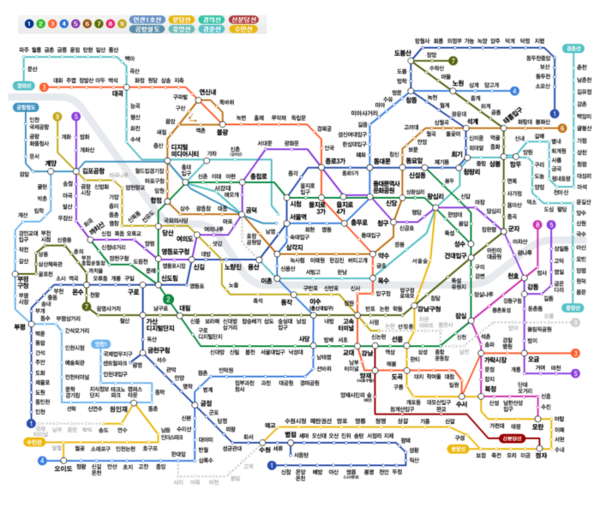
For international students newly arriving in Korea, the Korea subway map may look like a bewildering spider web. Major cities like Seoul, Busan, Daegu, Gwangju, and Daejeon each have several interconnected subway and urban rail lines, which can be overwhelming at first glance. However, once you get the hang of it, the subway becomes a highly efficient mode of transportation—not just for commuting or attending school, but also for weekend travel. In this post, we’ll cover how to better understand subway maps, tips for finding the quickest routes, and how to navigate transfer stations without getting lost.
1) Using Subway Map Apps and Guides
Gone are the days when people carried paper subway maps. Today, smartphone apps make it significantly easier to navigate. Popular apps like “KakaoMap,” “Naver Map,” “Seoul Metro App,” and “Subway Navi (하철이)” allow users to input a starting station and a destination to instantly get the optimal route, estimated travel time, and number of transfers. These apps even provide real-time information about train schedules and delays, which is a huge plus.
If you prefer a quick visual reference, you can also check the paper maps available at each station or view the wall signs posted inside. Although the lines may initially seem overwhelming, you’ll soon become familiar with the system as you regularly use specific routes, helping you grasp the overall layout naturally over time.
2) Understanding the Structure of Seoul’s Subway System
Seoul’s subway consists of nine main lines (Lines 1–9), alongside additional lines like the Shinbundang Line, Gyeongui-Jungang Line, and Airport Railroad (AREX). Key transfer stations include Seoul Station (Lines 1 & 4, KTX), Yongsan Station (Gyeongui-Jungang Line, Shinbundang Line), Wangsimni (Lines 2, 5, and the Bundang Line), Express Bus Terminal (Lines 3, 7, and 9), and Sindorim (Lines 1 and 2). By understanding the network around these key transfer hubs, it’s easier to comprehend the subway’s overall structure.
For instance, Line 2 is a prominent circle line that loops through central Seoul, while Line 1 functions as a regional (metropolitan) line extending to Incheon, Suwon, Cheonan, and other areas. Line 9 connects with AREX and offers quick access from western regions like Gangseo to Gangnam. Rather than trying to memorize all the lines at once, it’s much more efficient to first familiarize yourself with those relevant to your frequently visited areas.
3) Subway Systems in Busan, Daegu, Gwangju, and Daejeon
Outside the Seoul metropolitan area, cities such as Busan, Daegu, Gwangju, and Daejeon also operate urban rail systems. Although they have fewer lines than Seoul, the subway remains a fast and convenient way to get around. For example, Busan has Lines 1 to 4 and the Gimhae Light Rail, making it easy to travel to popular districts like Haeundae, Seomyeon, and Nampo via subway. Daegu operates Lines 1, 2, and 3, with Line 3 offering a unique monorail experience.
Gwangju and Daejeon currently each have just one line—Gwangju Line 1 and Daejeon Line 1—which connect their respective central areas. Many key destinations with heavy foot traffic are located near subway stations. Using the subway in combination with buses makes getting around these cities even more convenient.
Transfer stations are where multiple lines intersect, requiring passengers to walk through connecting corridors to switch trains. In Seoul, many of these corridors are long and complex—walking blindly through them may leave you confused and disoriented. To avoid this, pay close attention to the signage. Arrows labeled “Transfer to Line ○” are posted throughout stations, and following these cues usually leads you the right way.
Some subway apps also provide details on which train car to board to make your transfer easier. For instance, it may say “On Line 2 inbound, between cars 3 and 4 is closest to the Line 3 transfer corridor.” Knowing this in advance lets you choose your boarding position wisely, shortening the physical distance during transfer and saving time.
5) Finding the Fastest Route: Minimal Transfers vs. Shortest Time
When searching for subway routes, you might notice that “Minimal Transfers” and “Shortest Time” options provide different paths. The former has fewer transfers, making it more comfortable but possibly slower, whereas the latter is faster but may involve multiple transfers, which can be inconvenient. If you’re carrying heavy luggage or dislike switching lines, go with Minimal Transfers. But if you’re commuting during busy hours and speed matters, the Shortest Time route may be the better choice—even with extra transfers.
Some lines also offer express trains. For example, Line 9 and the Bundang Line have express services that skip certain stations, cutting down travel time significantly. However, pay attention—boarding the wrong express train could cause you to miss your stop, so always verify whether you’re on an express or regular service.
6) Avoiding Rush Hour Crowds
Seoul and the surrounding regions experience extreme subway crowding during weekday rush hours (7–9 AM and 6–8 PM). During this time, trains are so packed that it can be difficult to move or even use your phone. If possible, avoid these hours, or at least learn to identify the less crowded train cars.
As an international student, adjusting your class schedule slightly can help. For example, arriving on campus an hour earlier to study in the library, or leaving a bit later, may help you avoid peak congestion. On weekends, trains through central Seoul may be crowded with tourists, so plan accordingly if you want to avoid busy areas.
7) Lost and Found Services and Safety Guidelines
It’s not uncommon to lose items like bags or phones on the subway. In such cases, contact the Lost and Found department operated by the relevant transit authority. For Seoul: Lines 1–8 are managed by Seoul Metro, Line 9 by Seoul Metro Line 9 (a private operator), and lines like Bundang, Gyeongui-Jungang, and AREX by Korail or respective agencies. You can inquire in person or by calling the station office.
In terms of safety, platform screen doors (PSDs) are generally in place, offering protection. However, during busy times, it’s important to be mindful of pushing and overcrowding. Also, practice basic manners: give up priority seats for the elderly or pregnant passengers, be cautious on stairs and escalators, and watch your step on crowded platforms.
8) Connecting Trains and Subways for Intercity Travel
Beyond the greater Seoul area, many regional cities operate subways or are accessible via high-speed trains like KTX and SRT. For instance, you can take a KTX train from Seoul Station to Busan Station, then transfer to Busan Line 1 to reach Seomyeon or Haeundae. This kind of rail-subway connection shortens travel itineraries and also helps save on transportation costs.
In addition, most cities offer partial fare discounts for transferring between subways and city buses using a transportation card. Be sure to review the local transfer policy of each city, as rules may vary slightly from place to place for a smoother travel experience.
9) How to Respond to Emergency Situations
While rare, emergency situations can occur—such as train malfunctions, delays, or sudden incidents. In these cases, always listen to the station or on-board announcements and follow instructions to move to a safe area. If a train stops inside a tunnel, do not attempt to open the doors or step onto the tracks. Korea’s subway system has thorough safety measures and guidance systems in place, so staying calm and following directions usually ensures a safe resolution.
If your train is delayed due to transfer errors or unexpected issues, check your subway app for alternative routes, or consider switching to a bus or taxi for part of the journey. In some instances, buses may even be faster than the subway, so it pays to compare options.
10) Conclusion
Korea’s subway system is known for its vast and interconnected networks. Though it may appear confusing at first, frequent use will help you become familiar with the station names and line structures, making city navigation easier. Plus, transfer discounts via transportation cards provide major cost savings. By using apps and understanding the layout of transfer stations and train schedules, you can move about confidently without the fear of getting lost.
Whether you’re staying in Seoul or exploring other cities like Busan, Daegu, Gwangju, or Daejeon, the subway plays a critical role in student life. Planning weekend trips with KTX or SRT and learning local subway routes will let you discover Korea comfortably and economically. Mastering the subway system is a key step toward expanding your experience of life in Korea.
K-Name Studio: Create your perfect Korean name based on your personality and style.
What’s My K-Beauty Personal Color?
WeBring Service : Provides personalized services to foreigners living in Korea
Exclusive offer: Introducing foreign car rental in Korea, WeBring-SoCar
- Complete Guide: How to Get from Incheon Airport to Seoul – Airport Railroad vs. Pickup Service
- Korea Transportation Guide: Subway, Bus, Taxi & KTX for Foreigners
- Korail Pass Complete Guide: Routes, Reservations and Fares for Foreign Train Travel in Korea
- For Foreigner KTX, Buses, and Flights – The Complete Guide to Travelling Between Cities in Korea
Last updated: 22 September 2026
Rules, fees and procedures can change over time. Before an important decision, check the latest guidance from the relevant authority.
WeBring operates its own services for foreign residents in Korea. The following is a promotion for those services.
Living in Korea? You don't have to figure it out alone
Insurance, visas, jobs and hospital interpretation — WeBring supports every step of settling in Korea, in your language.