Jeju Oreum Trekking: Complete Guide to Easy Scenic Courses
Jeju Oreum Trekking: Another Side of Jeju Beyond Hallasan
Jeju oreum trekking is the most efficient way to experience Jeju’s nature without climbing Hallasan’s summit. When people think of hiking on Jeju, Hallasan usually comes to mind first, but the island has far more to offer. Across Jeju there are 368 oreum, small volcanic cones formed during Hallasan’s eruptions, most of them between 100 and 400m above sea level. Beginners can reach the top in 30 minutes to an hour, and every oreum has a different crater shape, ridge line, and surrounding view — revealing a side of Jeju that Hallasan alone cannot show.
This guide focuses on the easiest Jeju oreum trekking courses with the most dramatic summit views, suitable for family and casual day trips. You’ll find walking times, viewpoint highlights, nearby café and beach loops, and the best seasons for each course — all in one place.
What Is an Oreum: Terrain and Features of Jeju Oreum

Oreum is a Jeju dialect word meaning “a place to climb up,” referring to the small volcanic cones that formed alongside Hallasan’s eruptions. The most common shape is a rounded cinder cone, but you’ll also see long ridge-type oreum and horseshoe-shaped craters. Because most are under 300m above sea level, sneakers are enough — no hiking boots needed. From the summit you’ll see a panorama of Jeju’s coastline, Hallasan, and other oreum nearby, giving you a high reward for very little time invested.
Each oreum carries its own legend and naming origin. Darangshi Oreum is named for its moon-round crater, Yongnuni Oreum for a ridge shaped like a reclining dragon, and Saebyeol Oreum because it looks like a morning star rising from the plain. From the top you can see grazing horses on the open pastures and the horizon where sea meets sky — the moment the standard Jeju itinerary, often clustered around Hallasan’s foothills, naturally expands east, west, and into the mid-mountain region. For trail status and official information, check Visit Jeju (Jeju Tourism Organization).
Jeju Oreum Trekking at a Glance: Beginner and Intermediate Course Comparison
| Oreum | Elevation | Round Trip | Difficulty | Summit View | Best Season |
|---|---|---|---|---|---|
| Yongnuni Oreum | 247m | 40–60 min | Beginner | 360° hills & plains | Winter (golden) / Spring (new growth) |
| Saebyeol Oreum | 519m | 40–50 min | Beginner | Hallasan & western ridge sunset | Jan–Mar (Fire Festival) / sunset |
| Darangshi Oreum | 382m | 80–100 min | Intermediate | Crater + eastern oreum cluster | Autumn silver grass / new growth |
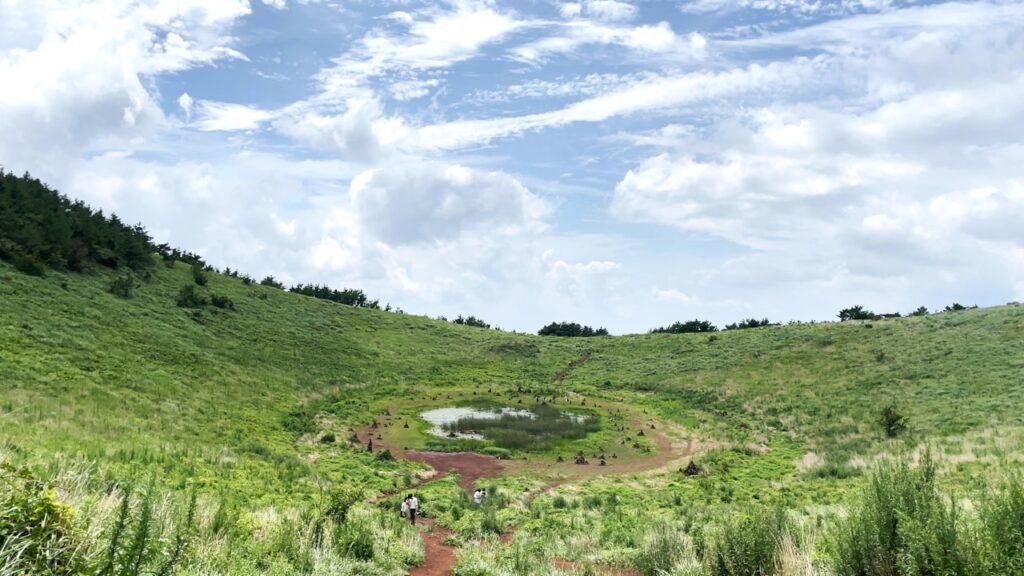
| Abu Oreum | 301m | 20–30 min | Easy | Circular crater grassland | All seasons |
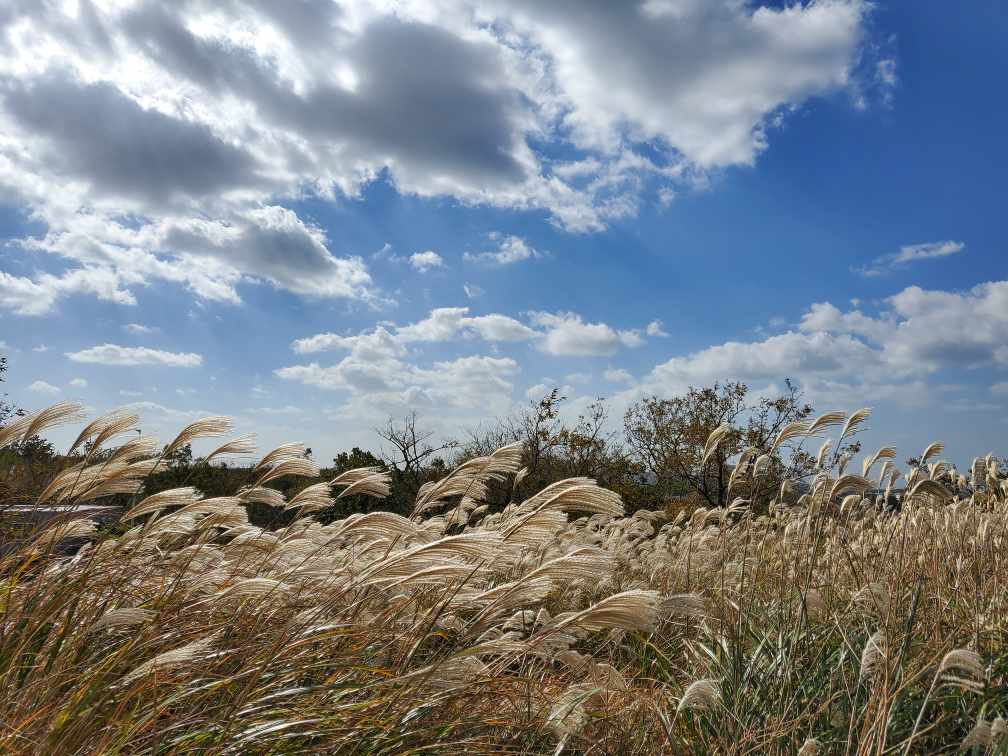
| Tarabi Oreum | 342m | 50–70 min | Beginner | Curved ridge & silver grass | Autumn silver grass |
The five oreum in the table are split between east Jeju (Yongnuni, Darangshi, Abu, Tarabi) and west Jeju (Saebyeol), so you can easily pair one or two in a single day. By car, the eastern oreum cluster is within 20–30 minutes of the Gujwa or Pyoseon area, and Saebyeol Oreum is about 15 minutes from Aewol or Hallim.
Beginner Picks for Jeju Oreum Trekking: Yongnuni and Saebyeol
Yongnuni Oreum stands at 247m with a gentle slope, making it accessible for everyone from young children to senior travelers. It takes about 30 minutes from the parking lot to the summit, and once there a well-maintained loop trail follows the ridge for full 360° views. To the east you’ll see Seongsan Ilchulbong, to the west Hallasan, and in between the curving silhouettes of Darangshi and Abu Oreum. Photographers visit most often in winter (golden-brown fields) and early spring (fresh green sprouts). Note: a rest-year system applies to protect the trail, so check Visit Jeju notices before going.
Saebyeol Oreum peaks at sunset. At 519m it has a slightly steeper section, but the palm-mat trail makes sneakers perfectly fine. From the top, the Hallasan silhouette and the sun setting over the western plain rank among Jeju’s most memorable sunset scenes. In early March each year, the Jeju Fire Festival sets the entire face of Saebyeol Oreum ablaze — a once-a-year spectacle you can witness up close if you time your visit. For travelers without a car, see Korea Transportation Guide first to compare bus and rental car options.
Intermediate Jeju Oreum Trekking: Darangshi Oreum and the Crater View
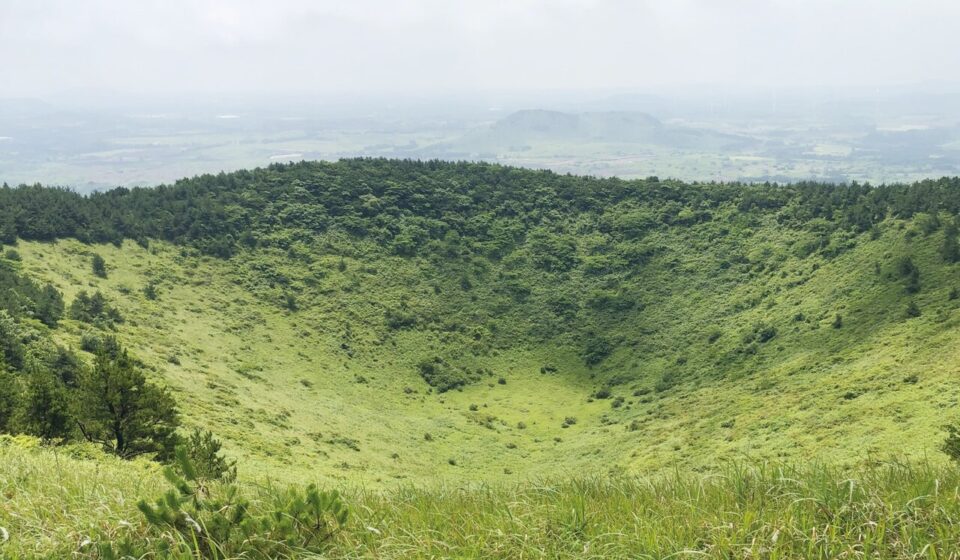
For a more substantial oreum hike, head to Darangshi Oreum. At 382m elevation and 80–100 minutes round trip, it’s the longest of the five courses in the table. At the summit, a massive circular crater opens beneath you — about 115m deep and 1.5km in circumference. The rim loop trail offers a layered three-dimensional view: Udo Island and Seongsan Ilchulbong to the east, Hallasan to the west, and Abu and Yongnuni Oreum directly below.
The area around the Darangshi Oreum trailhead has quiet rural villages and small cafés, perfect for a light meal or coffee after the hike. The path from the parking lot to the trail entrance is lined with vegetable plots and batdam (Jeju’s traditional stone walls), showing the layers of agricultural life built on top of volcanic terrain. A 5-minute walk away is the historic site of “Lost Village Darangshi” from the Jeju 4·3 incident, worth a visit if you have time.
Jeju Oreum Trekking Essentials and Safety Tips
Oreum trekking is lighter than typical hiking, but it’s still outdoor activity on natural terrain, so packing right matters. Jeju weather can differ sharply between the coast and the mid-mountain area on the same day, and the island averages more than 130 rainy days a year — checking the forecast is essential.
- Footwear: Sturdy sneakers or light hiking shoes. Palm mats get slippery when wet — anti-slip soles recommended
- Clothing: Windbreaker plus a thin long-sleeve layer. Mid-mountain area feels 5–7°C cooler than the coast
- Water and snacks: At least 500ml per person; no shops at the summit
- Sun protection: Hat, sunglasses, sunscreen. Jeju’s UV index runs higher than mainland Korea
- Timing: Arrive 60 minutes before sunset for sunset shots, 40 minutes before sunrise for sunrise shots
- Mobile coverage: Generally available at summits, but some ridge sections have dead zones
Drone photography is banned on some oreum (natural monument protection zones), and stepping off the designated trail into the crater is enforceable. Carry your trash out, and stick to palm mats and decks to protect the vegetation. For how Jeju oreum trekking compares with mountain leisure in mainland Korea, see Gangwon Leisure Sports Guide.
Jeju Oreum Trekking and Nearby Travel Loops
After one oreum, spending the rest of the day at a nearby coastal village or café is the Jeju travel sweet spot. Here are the easiest regional loops to combine.
| Oreum | Area | Loop | Drive |
|---|---|---|---|
| Saebyeol Oreum | West (Aewol / Hallim) | Aewol café street → Hallim Park → Hyeopjae Beach | 15–25 min |
| Yongnuni Oreum | East (Gujwa) | Sehwa Beach → Woljeongri café street → Gimnyeong Seongseki Beach | 10–20 min |
| Darangshi Oreum | East (Gujwa) | Abu Oreum → Bijarim Forest → Pyeongdae coastal road | 10–25 min |
| Tarabi Oreum | Mid-mountain East (Pyoseon) | Gasiri Noksanro canola road → Tarabi Oreum → Pyoseon Beach | 15–20 min |
With oreum at the center of your itinerary, the standard Hallasan-focused route naturally spreads east and west, helping you sidestep the crowds at the major attractions. If you don’t have a car, combining Jeju bus 281 (express) with eastern village shuttles 711-1 and 711-2 will get you to Yongnuni, Darangshi, and Abu Oreum.
Jeju Oreum Trekking FAQ
- How many oreum can I do in a day?
- For courses under one hour round trip, 2–3 in a day is comfortable. If you include an intermediate one like Darangshi, plan for 1–2.
- Can I hike in the rain?
- Not recommended due to fog, slippery surfaces, and reduced visibility. Trails close when strong wind advisories (wind speed 14 m/s and above) are issued.
- Are there entrance fees?
- Most are free. A few sections such as Sangumburi and parts of Tarabi may pass through private land with separate signage.
- Is parking sufficient?
- Saebyeol and Yongnuni Oreum hold over 100 cars but fill up quickly at weekend sunset. Darangshi has a smaller lot of about 30 spaces.
Wrap-Up: Jeju Oreum Trekking Expands Your Jeju Trip
Jeju’s beauty isn’t limited to Hallasan. Carved into its 368 oreum are volcanic terrain, the agricultural culture of those who farmed the plains, and the historical traces of the Jeju 4·3 incident. From small hills you can summit in 30 minutes to an hour and a half, the 360° views and the texture of the wind communicate the breath of Jeju more directly than the Hallasan summit itself. On your next Jeju trip, set aside half a day and pick one or two oreum. Sneakers, a light backpack, and a quick weather check — that’s all the preparation you need.
K-Name Studio: Create your perfect Korean name based on your personality and style.
What’s My K-Beauty Personal Color?
WeBring Service : Provides personalized services to foreigners living in Korea
Exclusive offer: Introducing foreign car rental in Korea, WeBring-SoCar
Explore Korea's mountains — guides in your language
Courses, transport and seasonal tips for 30 mountains, from Bukhansan to Hallasan, available in 11 languages. Pick up essential travel Korean and find events for the global community, too.