How to Use a T-money Card: Complete Guide for Foreign Travelers in Korea
Once you learn how to use a T-money card, getting around Korea becomes dramatically easier. The T-money card lets you pay for subways, buses, and taxis with a single tap, and any transfer made within 30 minutes waives roughly the 1,200 KRW second fare. Pick one up at a convenience store inside Incheon Airport Terminals 1 or 2 the moment you land and the transportation headache for foreign travelers disappears on the spot.
How to Use a T-money Card: What Is T-money?
T-money is a prepaid transit card standardized by the Korea Transport Institute that pays for subway, bus, and taxi fares. The card itself costs 2,500 KRW at major convenience stores such as GS25, CU, and 7-Eleven, as well as subway station booths, and you can top it up with anywhere from 10,000 to 90,000 KRW at a time. Fares are deducted automatically from the balance, so you never need to fumble with coins or bills.
Card designs are diverse. You can choose from plain plastic cards, limited-edition BT21 or Kakao Friends versions, or NFC chips embedded inside SIM cards. Buying one at the airport before you begin your Insadong and Ikseondong day trip saves time from your very first subway transfer.
How to Use a T-money Card on the Subway: Transfers and Route Maps
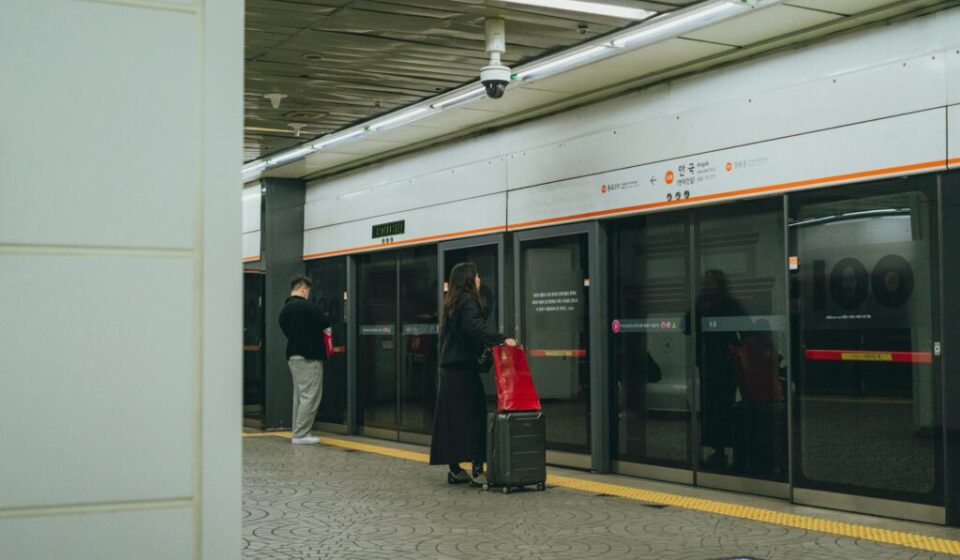
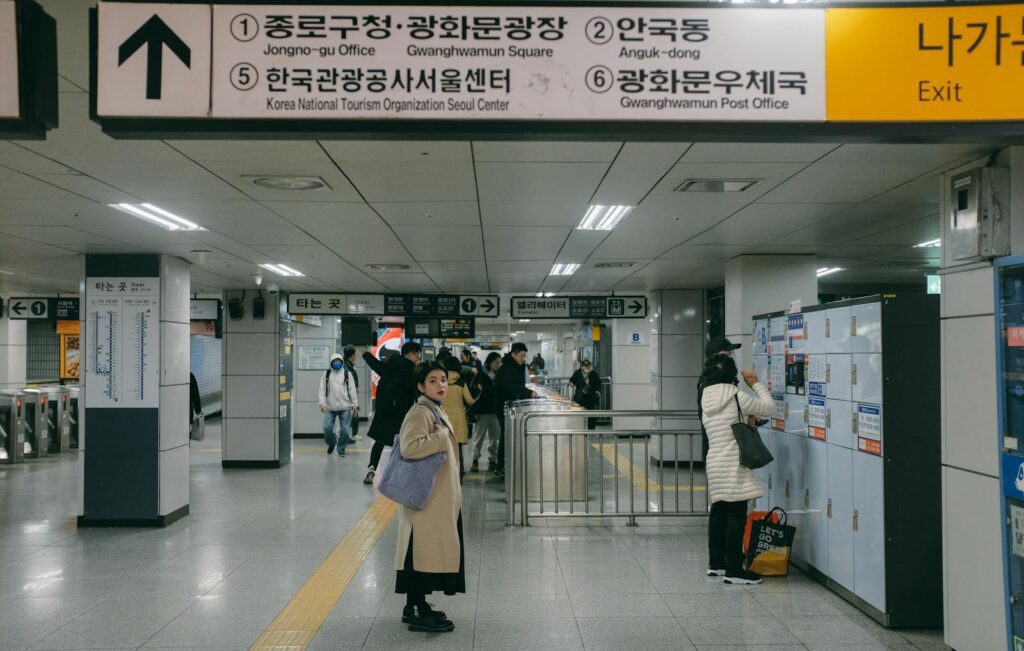
Seoul’s subway looks complex with 23 lines including Lines 1 through 9, the Bundang Line, Shinbundang Line, and Airport Railroad, but once you understand the map you can move quickly and cheaply. Tap your T-money card at the gate and the 1,400 KRW base fare is deducted, with an extra 100 KRW added every 5 km after the first 10 km. Any transfer completed within 30 minutes waives the second base fare entirely.
Every station is labeled in English, Chinese, and Japanese, and each line has its own color, so you can navigate without knowing Korean. Rush hours from 7 to 9 a.m. and 6 to 8 p.m. are crowded enough that carrying a suitcase is difficult, so avoid these windows if you have luggage.
How to Use a T-money Card on Buses: Routes and Colors
Seoul buses are divided into four colors by service area, and each color signals the line’s character. Tap your T-money card on the bus reader and the fare is charged instantly, and apps like KakaoMap or Naver Map show real-time bus positions and arrival times so first-time foreign riders rarely get lost.
| Color | Type | Service Area | Card Fare |
|---|---|---|---|
| Blue | Trunk | Long-distance through Seoul | 1,500 KRW |
| Green | Branch | Connects stations and trunk lines | 1,500 KRW |
| Red | Wide-area | Outer suburbs to downtown | 3,000 KRW |
| Yellow | Circular | Short downtown loops | 1,400 KRW |

How to Use a T-money Card in Taxis and What to Watch For
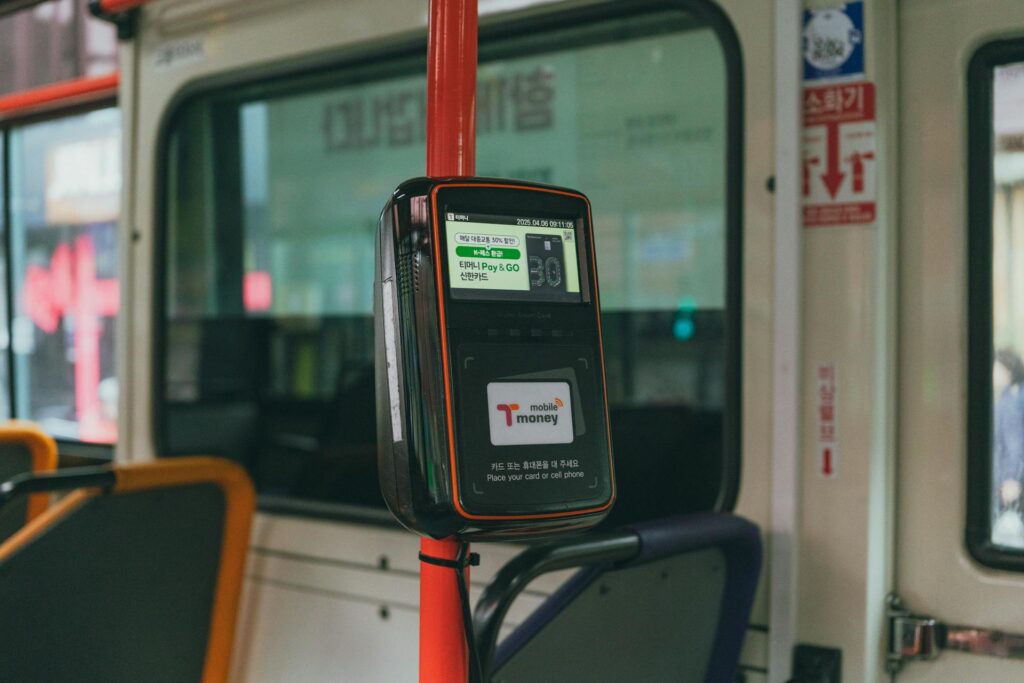
Taxis also accept T-money. Tap the card on the rear-seat reader and the fare is processed. Some independent taxis do not have card readers, so confirm “T-money okay?” before boarding. If your balance is insufficient the payment will fail, so check the remaining amount in advance. Kakao T-hailed taxis accept both in-app card payments and T-money taps.
How to Use a T-money Card to Score Transfer Discounts
Transfer discounts are the heart of how to use a T-money card well. If you switch from subway to bus or bus to subway within 30 minutes of tapping out, the second base fare is waived and only the distance surcharge applies. Compared with paying the 1,400 KRW and 1,500 KRW base fares in cash each time, four trips a day save you roughly 3,000 KRW.
Make full use of the transfer rules published by the Seoul Tourism Organization and the official T-money website and you can cut your transportation spending by 30 to 40 percent compared with an average tourist. It is the most reliable way to save on transit during a Seoul trip.
Pairing T-money With Your Smartphone NFC
On certain Android phones you can use the NFC feature to turn the handset itself into a T-money card. SKT, KT, and LG U+ counters inside Incheon Airport sell SIMs with T-money functionality built in, so you can ride without carrying a separate plastic card. Check compatibility with your foreigner prepaid SIM or eSIM plan before signing up. For first-time travelers a standard T-money plastic card is the safer option.
How to Use a T-money Card in Every Major Korean City
You can use T-money the same way in Busan, Daegu, Gwangju, Daejeon, and Incheon in addition to Seoul. A single card effectively unlocks the whole country. After visiting Bukchon Hanok Village, you can take the KTX to Busan or Jeju and keep using the same card. Just keep around 10,000 KRW of cash on hand, because some small-town village buses do not have readers.
Topping Up and Getting Refunds
You can top up at subway station kiosks and convenience store counters using either cash or a credit card. The kiosks offer English, Chinese, and Japanese menus, so the process is straightforward. At convenience stores, say “T-money charge, please” and state the amount you want to add.
You can claim balance refunds at convenience stores or station refund counters when you leave the country, though a fee of around 500 KRW applies, and balances above 20,000 KRW require a separate application. Many travelers spend down the balance in advance or keep the card as a souvenir for their next visit.
How to Use a T-money Card to Round Out a Korea Trip
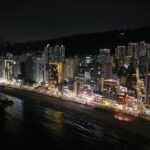
A T-money card is an essential item for maximizing transport convenience on a Korea trip. Three advantages — universal subway, bus, and taxi payment, the 30-minute transfer discount, and nationwide city compatibility — make your itinerary more efficient. Even when you head out at night to see Seoul night view spots, you can hop on a bus without worrying about catching the last train, which adds real flexibility to your schedule. Pick up a card at a convenience store the moment you land at Incheon Airport and top it up with just 10,000 KRW.
One small card becomes the key that unlocks Korea’s tangled public transit network in a single sweep. You barely need any language skills, and a single tap moves you anywhere. Keep your T-money card as a souvenir at the end of the trip and you can recharge the same card on your next visit.
K-Name Studio: Create your perfect Korean name based on your personality and style.
What’s My K-Beauty Personal Color?
WeBring Service : Provides personalized services to foreigners living in Korea
Exclusive offer: Introducing foreign car rental in Korea, WeBring-SoCar
Explore Korea's mountains — guides in your language
Courses, transport and seasonal tips for 30 mountains, from Bukhansan to Hallasan, available in 11 languages. Pick up essential travel Korean and find events for the global community, too.