
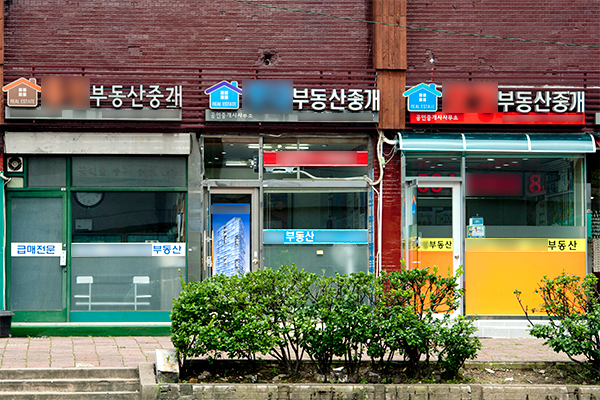

If you’ve started living in Korea long-term—for studying, work, or any extended stay—you’ll eventually need to find the right place to live. From small studio apartments to two-room units, officetels, or full apartments, the options are diverse, and with complex rental systems such as jeonse and monthly rent, the process can feel confusing at first. On top of that, if you’re unfamiliar with how to work with a licensed real estate agent (gongin junggaesa) or how to handle a real estate contract, the stress can multiply.
This guide will walk you through essential steps and tips for finding housing in Korea. We’ll cover what to know when working with realtors, key precautions during the contract process, and how to make the most of popular real estate apps like “Zigbang” and “Dabang.”
Understanding the Role of Real Estate Agents (Gongin Junggaesa)
In Korea, the most common way to look for a property is by visiting a licensed real estate office (gongin junggaesa samuso). These licensed agents are registered professionals who have passed an exam authorized by the Ministry of Land, Infrastructure and Transport. They act as intermediaries, connecting property owners (landlords or sellers) with tenants or buyers, and receive a commission fee upon successful contracting.
Foreigners go through the same process as locals. However, because of potential language barriers, it’s best to find an agent who can speak basic English or to bring a friend to help with interpretation. Since all Korean contract documents must be written in Korean, make sure to either request a detailed explanation from your agent or obtain a translated version to ensure a safe agreement.

Setting Your Criteria: Location, Budget, Layout, and Move-in Date
Before contacting real estate offices, clarify what kind of place you’re looking for. Decide whether location is your top priority or if you’re willing to compromise on area based on deposit and rent price. Consider how close you need to be to your school or workplace. Setting a clear budget helps your agent provide more efficient options.
For instance, saying “A two-room apartment within a 10-minute walk to the subway, with a 20 million KRW deposit and rent under 500,000 KRW per month, available from mid-next month” helps the agent quickly filter listings. On the other hand, vague requests like “somewhere cheap and nice” make it difficult for them to assist. The move-in date should also be discussed in advance so the landlord can prepare or finish maintenance in time.
Using Real Estate Apps (Zigbang & Dabang): Finding the Right Listing
Recently, real estate apps such as Zigbang and Dabang have become extremely popular in Korea. On these platforms, you can explore listings for various properties—studios, officetels, two-room apartments, and more—accompanied by photos and details. Users can filter results by rent type, deposit, size, floor, and structure, and even check the map view to examine nearby conveniences. This allows you to preview potential homes without physically visiting every area.
That said, always beware of fake or outdated listings. In the past, some agencies posted exaggerated or false ads to attract clients, though platforms have tightened regulations recently. Even so, before visiting, always call the agent listed in the app to confirm whether the property is real, still available, and if the conditions have changed.
Inspections Before Contract: Property Condition, Market Price, and Title Verification
Once you’ve shortlisted potential homes, always visit in person. Signing a lease based only on photos might reveal unexpected issues—like mold, poor ventilation, or noise problems. During your visit, open windows to check light and air quality, assess traffic noise, and test water, electricity, and internet availability. If furnishings like a stove, refrigerator, or air conditioner are included, check that they work properly.
Before signing, verify the property’s legal status and market value. For rent or jeonse agreements, request the property’s registration certificate (deung-gi-bu deung-bon). This document confirms the landlord’s ownership and shows any existing loans or liens. If the price seems too low compared to similar properties nearby, that might be a red flag—make sure your agent isn’t exaggerating or misrepresenting the value.
Signing the Contract: Ensuring Tenant Protection
Once you’ve decided on a property, it’s time to sign the official lease agreement (jutaek imdaecha gyeyakseo). The contract specifies the address, landlord and tenant details, deposit and rent (jeonse or monthly), lease duration (typically two years), agency commission, and key payment dates. The initial deposit—usually about 10% of the total—is paid upon signing but can be negotiated.
Afterward, you’ll pay the remaining balance on the agreed date and receive keys or a digital door lock code, making the home officially yours to move into. That’s also when the agent’s commission is paid. Foreign tenants should provide their Alien Registration Card number and sometimes a passport copy. If the agent requests separate escrow or other extra fees, confirm their legitimacy before paying.
Address Registration and Fixed Date: Legal Protection for Tenants
After completing your lease contract, file your move-in notice (jeonip singo) immediately at your local district office or community center (gucheong or haengjeong bokji center). This registers your new address officially and ensures you can receive mail properly. It also activates your legal protection under the Housing Lease Protection Act.
If you’re leasing with a jeonse contract, obtaining a “fixed date” (hwakjeong ilja) is equally essential. This certification records the date of your lease contract, giving you legal priority for deposit reimbursement in case the property is auctioned. It’s a critical layer of safety for anyone—especially foreigners—renting in Korea.
Commission Fees and Communication
The agent’s commission fee (junggae bosu) is determined based on the transaction type and total deposit or sale value, according to legal limits (e.g., around 0.5%–0.9%). While small negotiations are sometimes possible, paying too little may reduce the agent’s motivation or affect service quality.
Communication is one of the biggest challenges for foreign renters. If your agent doesn’t speak English, consider using translation tools or enlisting a bilingual friend to ensure you fully understand every contract detail. Alternatively, look for agencies specializing in foreign clients—common near international schools or expat neighborhoods—for smoother interactions.
Combining Apps and Agency Support
Apps and agents are not alternatives — they work best in sequence. Walking into a neighbourhood agency cold usually stalls on language, and booking viewings purely from app photos means you learn nothing about the building until you are standing in it. Use the app to narrow the field, then use an agent to close.
- Filter in the app — Zigbang or Dabang let you filter by area, deposit and monthly rent, and size. Shortlist on photos and specs before you contact anyone.
- Call the agent listed on the listing — Agents who advertise on the apps deal with foreign tenants more often, so basic English is more likely than at a walk-in office. Confirm the listing is still available before you travel to view it.
- View the property in person — Check water pressure, mould around windows, whether the boiler works, and mobile reception. Photos will not tell you any of this.
- Review the 등기부등본 (title certificate) with the agent — Confirm the person signing is the registered owner and check what loans are secured against the property. This is the step that protects your deposit.
- Sign with the landlord present and pay the commission at the legally capped rate for your deposit and rent bracket. The agent should be able to show you the rate table.
Narrowing options in the app first makes the in-person stage shorter and gives you a price reference before negotiation. It also means that if one agent is unhelpful, you have other listings to move to rather than starting over.
Conclusion: Preparation and Diligence Are Key to a Safe Rental Process
Finding housing in Korea often involves a combination of using real estate apps and working with local agents. Start by gathering information through apps, then finalize the contract with an authorized agent. The most critical steps include verifying that the listing is real, inspecting the property in person, and checking the ownership record (deung-gi-bu deung-bon) and landlord credentials.
Even if language presents a challenge, don’t overlook explanations from your agent. Clearly communicate your desired conditions—deposit, jeonse or monthly rent, move-in date, layout, and amenities. Carefully review all documents before signing and, after moving in, complete your address registration and fixed-date certification for full legal protection.
While Korea’s housing system can initially feel complex to foreigners, it’s backed by well-established legal frameworks like the Housing Lease Protection Act and professional licensing for real estate agents. With patience, clarity, and balanced use of apps and professional help, you can secure a comfortable and safe home in Korea more easily than expected.
Balance Day Is the Riskiest Day
A month or two usually passes between the deposit and the balance payment. The registry position can change in that window, and not checking means discovering the problem after handing over the money.
- Pull a fresh registry extract on the morning of balance day. Do not rely on the one from signing day — a mortgage registered in between is a known method, not a hypothetical.
- Send money only to the landlord’s account as named in the contract. Refuse requests to pay an agent’s or a third party’s account.
- Check the signer’s ID against the registered owner. If they act as an agent, ask for the power of attorney and seal certificate.
- Do balance, keys and move-in registration on the same day. The gap between paying and registering is the most exposed interval there is.
- Get a receipt. A transfer record alone may not be enough.
In one line: check the registry → pay the balance → take the keys → complete move-in registration and the fixed date at the community service center. Schedule balance day in the morning so the office is still open.
Sentences to Put in the Special Clauses
The special clauses box at the end of the standard contract is what actually decides disputes. Leaving it blank leaves you nothing to rely on. Use only the ones your situation calls for.
- On mortgages — “The landlord shall not register any new mortgage before the balance date.”
- On defects — “Defects identified before move-in (boiler, leaks, etc.) shall be repaired at the landlord’s cost.” List the specific defects found.
- On repair responsibility — “Consumable replacements are the tenant’s cost; failures arising from age of the facilities are the landlord’s.”
- On residence status — “If the tenant must leave Korea because their residence status expires, the lease terminates on X months’ notice and the deposit is returned.” For anyone on a fixed period of stay, this is the most important line in the contract.
- On return timing — “The deposit shall be returned on the move-out date.” Without it, disputes follow.
A landlord refusing a clause is itself information. You do not need every clause, but you should hear the reason for the refusal. Never sign Korean text you do not understand, and ask for translation or interpretation where needed — it is a legitimate request.
K-Name Studio: Create your perfect Korean name based on your personality and style.
What’s My K-Beauty Personal Color?
WeBring Service : Provides personalized services to foreigners living in Korea
Exclusive offer: Introducing foreign car rental in Korea, WeBring-SoCar
- Korea Real Estate Contract Process: Complete 5-Step Guide for Foreigners
- Korea Housing Guide: Buying, Renting, and Leasing
- 10 Korea Apartment Red Flags When Renting: A Stage-by-Stage Checklist
- Finding a Studio in Seoul: Rental Guide for Foreigners on Apartments & Officetels
Last updated: 22 September 2026
Rules, fees and procedures can change over time. Before an important decision, check the latest guidance from the relevant authority.
WeBring operates its own services for foreign residents in Korea. The following is a promotion for those services.
Living in Korea? You don't have to figure it out alone
Insurance, visas, jobs and hospital interpretation — WeBring supports every step of settling in Korea, in your language.