

Korean Traditional Market Itinerary: 12 Routes With Historic Streets (Seoul, Busan, Jeonju, Gyeongju)

A Korean traditional market itinerary is more rewarding when you pair it with a nearby historic street. Combining the two turns the day into a complete “eat → walk → learn” experience. Here are 12 city-tested traditional market + historic street one-day itineraries across Korea, with routes, tips, and photo points all in one guide.
Why pair a Korean traditional market itinerary with a historic street
A traditional market shows the present-day life of a neighborhood at its most vivid. A historic street explains how the city became what it is today. Linking the two lets you understand a city through flavor (market) + context (history) + walking pleasure (alleys) in a single day. This combination works best both for explaining Korea to foreign visitors and for solo deep-dive travel.
One-day Korean traditional market itinerary formula
| Time | Suggested plan | Tip |
|---|---|---|
| Morning–lunch | Market snacks + light meal | Lines move fast; mix cash and mobile pay |
| Afternoon | Historic street / heritage walk + one cafe | Comfortable shoes are a must, bring wet wipes |
| Evening (optional) | Night market or night-view spot | Check night-market operating days in advance |
Nationwide Korean traditional market itinerary: 12 routes at a glance
Each route is selected for natural walking flow and a historical story that is easy to explain to foreign visitors.
| # | City | Market → Historic street | Highlight |
|---|---|---|---|
| 1 | Seoul Jongno | Gwangjang Market → Jongmyo / Insa-dong → Ikseon-dong Hanok Street | Joseon-era core + hanok mood |
| 2 | Seoul Seochon | Tongin Market → Seochon Hanok Village → Gyeongbokgung area | Brass-coin lunchbox + alley walk |
| 3 | Seoul Jung-gu | Namdaemun Market → Jeong-dong-gil (Deoksugung Stone Wall) | Shopping + modern history walk |
| 4 | Incheon Jung-gu | Sinpo International Market → Chinatown → Open Port Nuri-gil | 120-year open-port story |
| 5 | Suwon | Paldalmun Market → Hwaseong Fortress wall walk → Haenggung-dong | Market + UNESCO World Heritage fortress |
| 6 | Jeonju | Nambu Market → Jeonju Hanok Village (Gyeonggijeon-gil / Hyanggyo-gil) | Food + cluster of 700 hanok |
| 7 | Gunsan | Gunsan Public Market → Modern History Street (Time Travel Village) | Japanese-colonial-era modern architecture |
| 8 | Daegu | Seomun Market → Modern Culture Alley (Cheongna Hill line) | Day market + weekend night market |
| 9 | Busan | Gukje Market → BIFF Square → Jagalchi → Bosu-dong Book Street | Old downtown one-stop walk |
| 10 | Gwangju | Yangdong Market → Yangnim-dong History & Culture Village (Penguin Village) | Retro alleys + modern story |
| 11 | Gyeongju | Seongdong Market → Gyochon Village → Woljeonggyo Bridge (night view) | Silla history + night photography |
| 12 | Jeju (Jeju City) | Dongmun Market → Jeju Mokgwana / Gwandeokjeong → Old downtown | Last-day-before-flight route |
Detailed Korean traditional market itinerary by route
1) Seoul Jongno: Gwangjang Market → Jongno historic district → Ikseon-dong Hanok Street
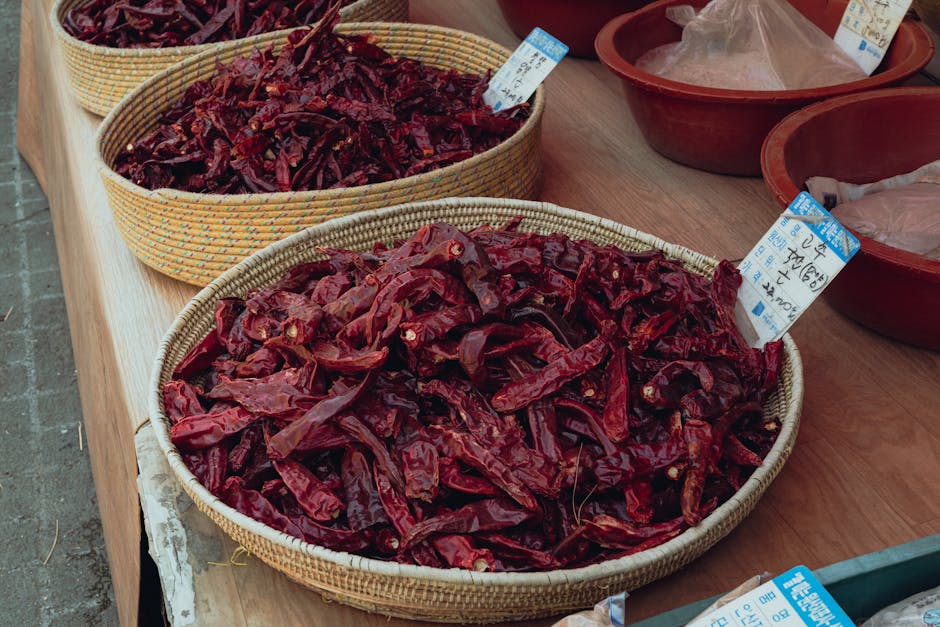
Why this route: Eat “everyday Seoul food,” walk through “the heart of Joseon,” and finish with “hanok atmosphere.” This is the signature Korean traditional market itinerary in Seoul.
- Start: Gwangjang Market (food alley) — general shops 09:00–18:00, restaurants and food alley 09:00–23:00, closed Sundays
- Walk: Jongmyo area (historic) → Insa-dong (traditional crafts and tea houses)
- Finish: Ikseon-dong Hanok Street (cafes, desserts, photo-friendly alleys)
Handy English line for the market: “This is a traditional Korean market.” / “Can I get one bindaetteok, please?” (mung-bean pancake)
Gwangjang Market is one of the oldest permanent markets in Seoul, famous for signature dishes like bindaetteok, mayak gimbap, and yukhoe. Avoid the lunch rush (12:00–13:00) for a calmer visit. Jongmyo is a UNESCO World Heritage site where Joseon royal ancestral rites are still performed every spring and autumn. Ikseon-dong Hanok Street is a cluster of 1920s–30s hanok houses turned into cafes and restaurants, and the alleys themselves are a photo destination.
2) Seoul Seochon: Tongin Market → Seochon Hanok Village → Gyeongbokgung line
Why this route: The hands-on brass-coin lunchbox market pairs naturally with a Joseon-era city alley walk.
- Start: Tongin Market — 07:00–21:00, closed every 3rd Sunday / lunchbox cafe closed Tuesdays and every 3rd Sunday
- Walk: Seochon Hanok Village walking course (alleys, hanok, small galleries)
- Option: Around Gyeongbokgung (when you have extra time)
Keep lunch light with market snacks and a brass-coin lunchbox, then add one Seochon cafe — the route times almost perfectly.
3) Seoul Jung-gu: Namdaemun Market → Jeong-dong-gil (Deoksugung Stone Wall line)
Why this route: A dense shopping-and-food market flows naturally into a street that still carries Seoul’s modern history.
- Start: Namdaemun Market — 00:00–23:00, closed Sundays (varies by shop)
- Walk: Jeong-dong-gil — a walk lined with modern cultural and diplomatic landmarks
Jeong-dong-gil feels like “Old Seoul meets modern history,” which makes it easy to explain to foreign visitors.
4) Incheon Jung-gu: Sinpo International Market → Chinatown → Open Port Nuri-gil
Why this route: A single day captures both the flavor and the open-port story of the harbor city of Incheon.
- Start: Sinpo International Market — 10:00–21:00 (varies by shop)
- Walk: Incheon Chinatown — over 120 years of history, with jajangmyeon, gonggalppang, and mooncakes as signature foods
- Finish: Open Port Nuri-gil (modern-era street walking route)
- Option: Jajangmyeon Museum (hours and closing days subject to change)
Foreign guests respond especially well to this route. The Chinatown → Open Port flow is strong for storytelling. Sinpo’s dakgangjeong (sweet crispy chicken) is famous nationwide, and gonggalppang gets its name from its hollow inside — a fun snack to try. The Open Port Nuri-gil traces a district that grew after the 1876 Treaty of Ganghwa as a foreign settlement, and Japanese, Western, and Chinese-style buildings still coexist within a single block.
5) Suwon: Paldalmun Market area → Hwaseong Fortress wall walk → Haenggung-dong
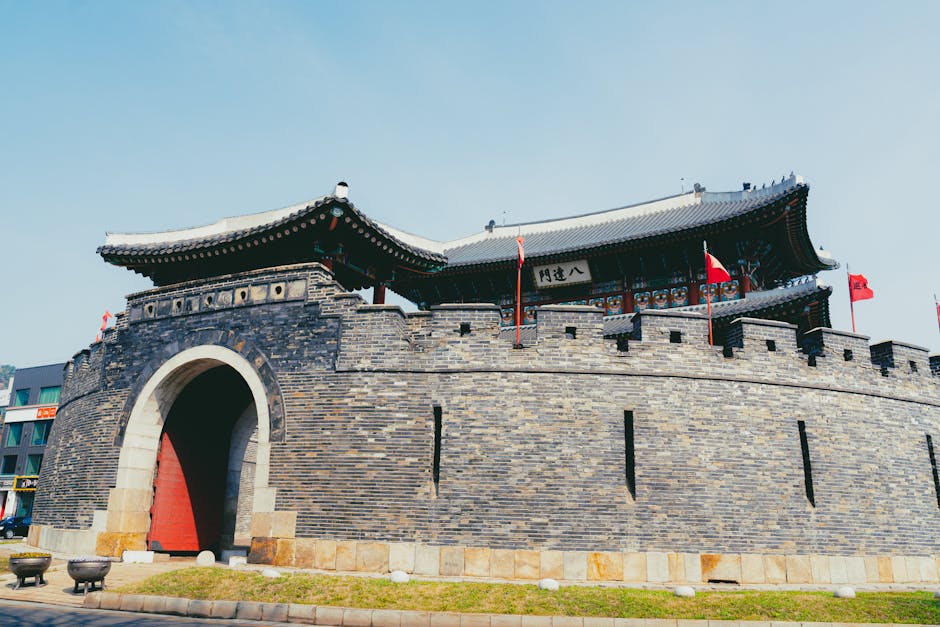
Why this route: The market-plus-fortress-walk combination raises the completeness of this Korean traditional market itinerary all on its own.
- Start: Traditional market cluster around Paldalmun (south gate)
- Walk: Hwaseong Fortress wall — a 1–2 hour course (Paldalmun → Seojangdae → Hwaseomun and other variations)
- Finish: Haenggung-dong cafes and alleys
The fortress wall is windy, so a scarf and gloves are essential in winter. Hwaseong was registered as a UNESCO World Heritage site in 1997 and is a masterpiece of late-Joseon architecture. The Paldalmun market cluster connects Paldalmun Market, Nammun Market, and Yeongdong Market, and lets you try Suwon classics such as sundae gukbap and wang galbi tongdak. Haenggung-dong Mural Village near Hwaseong Haenggung is a great post-walk stroll thanks to its painted alleys.
6) Jeonju: Nambu Market → Jeonju Hanok Village (Gyeonggijeon-gil / Hyanggyo-gil)
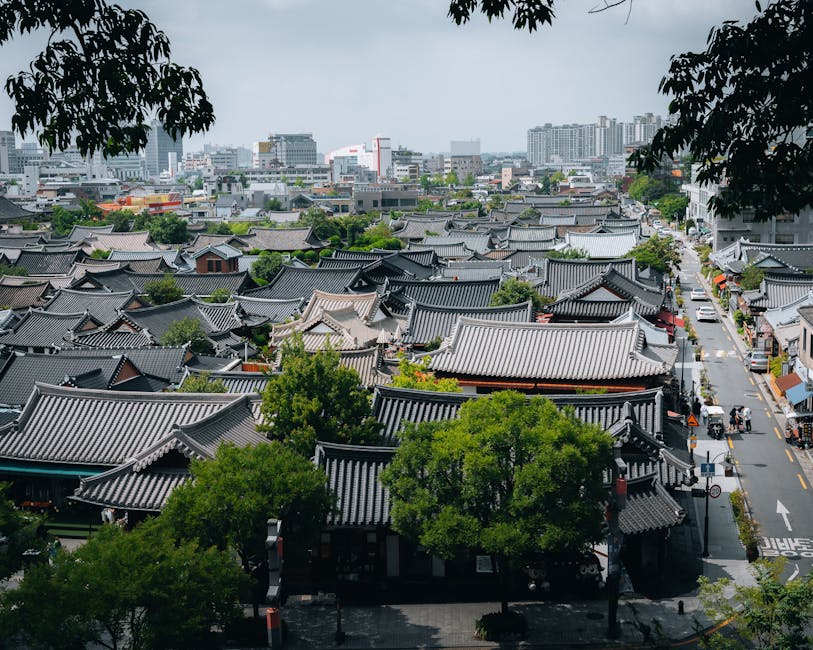
Why this route: The most classic way to enjoy Jeonju is through food and hanok together.
- Start: Jeonju Nambu Market — 09:30–23:00 (varies by shop)
- Walk: Jeonju Hanok Village — about 700 hanok houses around Pungnam-dong, plus heritage sites such as Gyeonggijeon and Jeonju Hyanggyo
- Key spot: Gyeonggijeon — open 09:00–18:00 / 20:00 depending on the season
Hanok rooflines and night-time alley lighting are top photo points. Renting a hanbok lifts the visual story even more. The Cheongnyeonmol (Youth Mall) on the second floor of Jeonju Nambu Market gathers small restaurants run by young chefs and pairs well with traditional market food. Gyeonggijeon enshrines the royal portrait of Joseon’s founder Yi Seong-gye, and you can check details on the Korean Heritage Service portal.
7) Gunsan: Gunsan Public Market → Modern History Street (Time Travel Village)
Why this route: The easiest day-route for reading the modern city of Gunsan.
- Start: Gunsan Public Market — 09:00–21:30 (varies by shop), closed every 1st and 3rd Sunday
- Walk: Gunsan Modern History Museum and modern street (Time Travel Village)
Travel from market to modern architecture is fairly clean. Taxis or buses work well. Gunsan Public Market is famous for fresh seafood and local specialties, especially salted seafood and ggotgejang (marinated blue crab). The “Time Travel Village” district preserves Japanese-era buildings such as the Hirotsu House and the former Gunsan Customs Office in near-original condition. The area conveys both the colonial-era exploitation and the everyday life of Koreans at the time, leaving a strong impression on foreign visitors learning about modern Korean history.
8) Daegu: Seomun Market → Modern Culture Alley (Cheongna Hill line)
Why this route: Daytime market plus evening night market — a full-day course is possible.
- Start: Daegu Seomun Market — 09:00–18:00, closed every 1st and 3rd Sunday
- Walk: Modern Culture Alley / Cheongna Hill (modern-history walking route)
- Evening (optional): Seomun Night Market — Fri/Sat 19:00–23:30, Sun 19:00–22:30 (closed Mon–Thu)
“Daegu has one of the best night markets in Korea.” is a line that lands well. Seomun Market dates back to the Joseon era and is the largest traditional market in Daegu; the night market is among the country’s top street-food festivals. The Modern Culture Alley is a five-route walking program organized by the city, including Cheongna Hill (with mission-school heritage buildings), the March 1st Independence Movement Path, and the Yi Sang-hwa house. The full course takes about two hours and is a tightly packed history walk.
9) Busan: Gukje Market → BIFF Square → Jagalchi → Bosu-dong Book Street
Why this route: The definitive walking line for Busan’s old downtown in a single shot.
- Start: Gukje Market — 09:00–20:00, closed every Sunday
- Walk: BIFF Square (the heart of Nampo-dong)
- Food: Jagalchi Market — 05:00–22:00, closed every 1st, 3rd, and 5th Tuesday
- Book & retro: Bosu-dong Book Street — closed every 1st and 3rd Tuesday, most stores close around 20:00
- Night (optional): Bupyeong Kkangtong Night Market — daily 19:30–24:00
Gukje Market → BIFF → Jagalchi → Bupyeong Night Market connects almost entirely on foot or by short transit ride, so first-timers rarely fail. Gukje Market was built right after the Korean War by displaced refugees and now stocks dried goods, kitchenware, clothes, and street food — Busan’s largest traditional market. BIFF Square, the symbol of the Busan International Film Festival, even offers a hand-printing experience for visitors. At Jagalchi Market, you can pick fresh fish downstairs and have it served at the second- or third-floor restaurants, which is also popular with foreign visitors.
10) Gwangju: Yangdong Market → Yangnim-dong History & Culture Village (Penguin Village)
Why this route: Connects Gwangju’s everyday market to retro and modern-history stories.
- Start: Yangdong Traditional Market (including Yangdong Bokgae Arcade) — 09:00–21:00, closed every 1st and 3rd Sunday
- Walk: Yangnim-dong History & Culture Village
Yangnim-dong has wonderfully photogenic alleys. Pick up snacks at the market to enjoy on the walk. Yangdong Market is the oldest traditional market in Gwangju and a great place to try yukhoe bibimbap and jumeokbap. Yangnim-dong History & Culture Village preserves the homes and churches of American missionaries who worked in Gwangju in the early 1900s, and Penguin Village is a quirky alley where residents turned discarded items into art. The neighborhood also offers context for understanding Gwangju’s role in the May 18 Democratic Movement.
11) Gyeongju: Seongdong Market → Gyochon Village → Woljeonggyo (night view)
Why this route: Experience the city of Silla through market, hanok, and night view in one natural flow.
- Start: Seongdong Market — 07:00–20:00, closed every 1st and 3rd Sunday (varies by shop)
- Walk: Gyochon Village
- Finish: Woljeonggyo Bridge — open 09:00–22:00
Gyeongju is especially beautiful at night. The market → heritage → Woljeonggyo night view sequence is incredibly strong for photo content. Seongdong Market is a daily-life market for Gyeongju residents and is famous for ssalyeot (rice taffy), barley bread, and Hwangnam-bbang. At Gyochon Village you can visit the Gyeongju Choi Family head house and Gyeongju Hyanggyo, and the Choi family’s “noblesse oblige” story is great material for explaining Korean traditional values to foreign companions. Woljeonggyo is a reconstructed Unified Silla bridge whose night lighting has made it an Instagram favorite.
12) Jeju (Jeju City): Dongmun Market → Jeju Mokgwana & Gwandeokjeong → Old downtown walk
Why this route: Beyond cars and beaches, this Jeju day route reveals the texture of the old downtown.
- Start: Dongmun Traditional Market — 07:00–21:00 / Night Market 18:00–24:00 (winter), 19:00–24:00 (summer)
- Walk: Jeju Mokgwana (including Gwandeokjeong) — 09:00–18:00 (last ticket 17:30)
- Heritage point: Gwandeokjeong (Treasure No. 322)
- Finish: Old downtown walk (Sanjicheon, Tap-dong, etc., near Dongmun Market)
The area is close to the airport, so it works as a “last-day shopping + walk” course. Dongmun Traditional Market is the best place to buy Jeju specialties such as tangerines, hallabong, black pork, and omegi-tteok. The night market offers Jeju versions of Korean street food (hallabong-ade, black-pork skewers) at affordable prices. Jeju Mokgwana, the administrative center of Joseon-era Jeju, has been excavated and restored, and Gwandeokjeong (built in 1448) is one of the oldest wooden buildings on the island. A walk along the Sanjicheon stream takes you through Jeju’s modern alley scenery.
Practical Korean traditional market itinerary tips (especially useful with foreign companions)
The following tips are based on the official travel information from the Korea Tourism Organization and on-site experience.
| Situation | Tip |
|---|---|
| Payment | Many shops take cards, but mixing in cash and mobile payment makes things smoother |
| One-line ordering | “이거 하나 주세요.” / “맵지 않게 해주세요.” / “포장 가능해요?” — English: “One, please.” / “Not spicy.” / “To go.” |
| Photo manners | Before close-up shots of vendors or other customers, ask “사진 찍어도 될까요?” (“Can I take a photo?”) |
| Trash | Trash cans are scarce in markets, so a small plastic bag in your daypack improves the day a lot |
Frequently asked questions
When is the best time to visit a traditional market?
Just before lunch (around 11:00) or in the evening (after 19:00 where there is a night market) gives the best atmosphere. Each market has its own hours, so check the operating info listed for each route above.
Are many markets closed on Sundays?
Some markets have announced Sunday closures (such as Busan Gukje Market and Seoul Gwangjang Market). If your trip falls on a weekend, planning around Saturday is recommended.
If you had to pick one “most Korean day” for a foreign friend, what would it be?
In Seoul, Gwangjang Market + Ikseon-dong; outside Seoul, Jeonju Nambu Market + Hanok Village; in a port city, Busan Gukje Market + Jagalchi — these combinations rarely miss.
Where should I go if I want to include a night market?
Daegu Seomun Night Market (weekends), Busan Bupyeong Kkangtong Night Market, and Jeju Dongmun Night Market are the main options.
Are there routes that work even on rainy days?
Indoor / arcade-style markets paired with modern streets full of cafes are the safest bet. Daegu (Seomun Market), Busan (Gukje Market area), and Incheon (Chinatown) routes are recommended.
What are some can’t-miss market dishes?
Bindaetteok and gimbap (Seoul), tteokbokki and other bunsik (nationwide), seafood (Busan), and traditional desserts and tea (hanok-village areas) are safe picks. Specific menus vary by stall.
Are there manners to observe on historic streets?
In residential alleys (hanok villages, Seochon, Ikseon-dong), simply avoiding loud noise and group blockages is usually enough.
What is the source of the operating hours and closures listed here?
The information is based on public data from local governments, the Korea Tourism Organization, and official tourism pages. Individual shops change hours from time to time, so a quick check just before visiting is the safest approach.
Can I follow this Korean traditional market itinerary on my own without a tour?
Yes — most routes work entirely with public transit and walking. Subway and bus lines reach every major market, and Naver Map or Kakao Map gives real-time directions if you search “전통시장” or the market name. If you travel solo, doing the market in the morning and the historic street in the afternoon saves energy.
K-Name Studio: Create your perfect Korean name based on your personality and style.
What’s My K-Beauty Personal Color?
WeBring Service : Provides personalized services to foreigners living in Korea
Exclusive offer: Introducing foreign car rental in Korea, WeBring-SoCar
- Korean Food Travel Guide: 12 Markets & Night Markets
- Seochon Walking Course: A Half-Day Hanok & Lunchbox Route (2026)
- Jagalchi Gukje Market Nampo course: Busan half-day guide
- Jeonju Gunsan 2 Nights 3 Days Course Guide: Tradition + Retro Route
Last updated: 22 September 2026
Prices, opening hours and transport schedules change with the season and the operator. Check the official channel again before you go.
WeBring operates its own Korea tour and vehicle services. The following is a promotion for that service.
Explore Korea's mountains — guides in your language
Courses, transport and seasonal tips for 30 mountains, from Bukhansan to Hallasan, available in 11 languages. Pick up essential travel Korean and find events for the global community, too.