

Hanbok Photoshoot Rural Village Guide: Stone Walls, Fields, Traditional Korean Photos
A hanbok photoshoot rural village session produces results that feel completely different from city palace photos. Step away from the crowds at Gwanghwamun or Jeonju Hanok Village, and stone walls, dirt roads, jangdokdae (earthenware jar platforms), and open fields make the beauty of hanbok come alive far more naturally. This article is a hands-on guide that breaks down the entire hanbok photoshoot rural village process — preparation, rental tips, location selection, poses, resident etiquette, and post-shoot rural experiences — into seven parts.
Hanbok Photoshoot Rural Village Charm: How It Differs From City Hanok Villages
Unlike city hanok villages, rural villages carry a quiet, natural atmosphere. Remaining thatched roofs, old storage sheds, a scarecrow at the village entrance, and worn dirt paths all blend with hanbok and bring out its elegance. Local residents often welcome travelers in hanbok and even guide them to hidden village spots. For information on regions where you can experience hanbok, check the Korea Tourism Organization (visitkorea.or.kr); for a comparison with palace routes, also see our Hanbok Palace Photo Travel Best Courses guide.
| Comparison | City Hanok Village (incl. Palaces) | Hanbok Photoshoot Rural Village |
|---|---|---|
| Backdrop | Tiled roofs, paved stone walls, dancheong | Thatched roofs, dirt walls, jangdokdae, open fields |
| Crowds | Several hundred to thousands on weekends | Usually single digits |
| Hanbok Rental | Many on-site, available immediately | Almost none, rent in the city in advance |
| Main Light | Strong building shadows | Easy to use sunrise/sunset golden hour |
| Resident Cooperation | None | Often guides or tea after a greeting |
Hanbok Rental and Rural Photoshoot Checklist
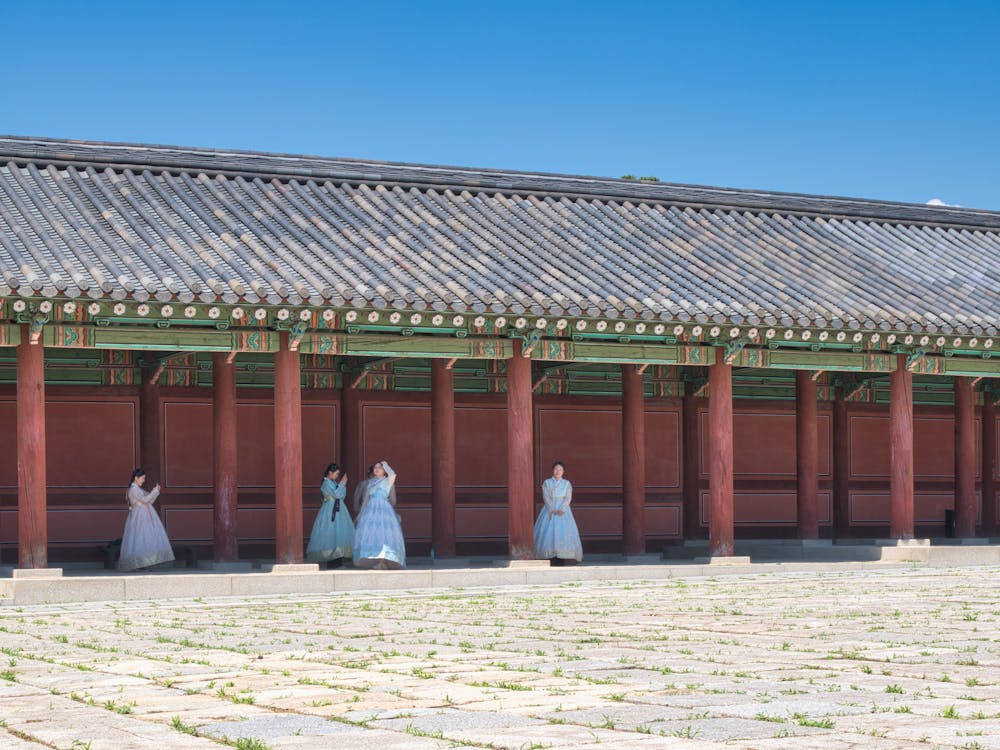
Rural villages rarely have hanbok rental shops, so the usual approach is to rent in a city beforehand and bring the outfit with you. Travelers often rent in Seoul, Jeonju, or Gyeongju where rental shops are plentiful and then shoot during their rural itinerary. Online rental services let you pick a design in advance, receive it by parcel, and return it the same way. Bright hanbok colors stand out best against rural backdrops, and packing accessories (norigae, jokduri, jobawi) along with flat flower shoes or plain flats keeps you stable on dirt paths. For communication and transit apps, you can sort everything at once in Essential Apps for Foreigners in Korea: 15 Picks.
- Hanbok set (jeogori + skirt): one bright color set + one plain color set
- Accessories: norigae, jokduri (or jobawi), hair ornaments
- Shoes: flower shoes or plain flats (for dirt paths)
- Underwear and underskirt: essential for hanbok silhouette
- Extra socks, invisible hair pins (for wind)
- Water, snacks, a small umbrella (rural areas have few amenities)
- Portable mirror, handkerchief, power bank
Hanbok Photoshoot Rural Village Locations: Best Stone Walls, Dirt Roads, Fields
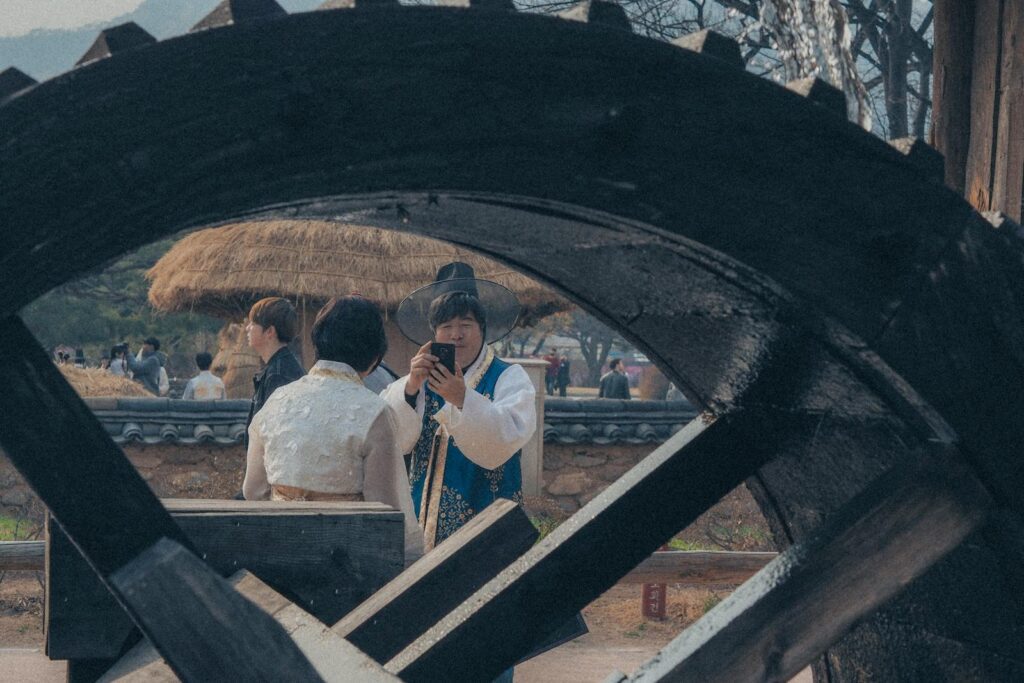
The most popular backdrop in a hanbok photoshoot rural village session is a stone wall lane. The texture of old village stone walls and dirt ground contrasts with the splendor of hanbok and creates a frame that looks like a Korean ink painting. Wells and jangdokdae carry strong atmosphere, while fields and rice paddies may be private land — but asking residents for permission before shooting almost always gets a friendly yes. For village etiquette itself, Korea Traditional Village Visit Etiquette Guide (Hahoe, Yangdong, Bukchon) is a useful reference.
Time of Day and Season: Hanbok Photoshoot Rural Village Light Tips
Light decides the photo. Aim for the golden hour right after sunrise or just before sunset, and hanbok colors come out most vividly. When the sun is high (10:00 a.m. to 2:00 p.m.), shadows get strong and faces turn dark, so schedule a hanbok photoshoot rural village session for early morning or late afternoon when possible. Spring pairs hanbok with wildflowers and plum blossoms; autumn brings golden rice fields and persimmon trees. For seasonal travel flow in Korea, see our Korea Travel Season Guide.
| Season | Recommended Backdrop | Hanbok Colors | Notes |
|---|---|---|---|
| Spring (Mar–May) | Wildflowers, plum, dirt walls | Pink, mint, soft purple | Pollen and wind |
| Summer (Jun–Aug) | Greenery, wooden floors, wells | White, sky blue | Sweat and heatstroke; ramie hanbok recommended |
| Autumn (Sep–Nov) | Golden fields, persimmon, foliage | Vermilion, magenta, gold | Big day-night gap; one warm layer |
| Winter (Dec–Feb) | Snowy thatched roofs, jangdokdae | Deep blue, magenta, deep red | Durumagi coat essential, cold |
Etiquette: Distance From Residents in a Hanbok Photoshoot Rural Village
Rural villages are often not set up as tourist sites. Parking can be tight and public restrooms scarce, so bring water and snacks; never block paths for long periods or enter private property without permission. Instead, greeting residents first with “This place is so beautiful — would it be okay to take photos here?” often earns a friendly guided tour. For befriending Korean locals as a foreign traveler, see our Making Korean Friends Complete Guide.
- Greet residents you meet at the village entrance and explain your shoot
- If a gate is closed, treat it as private property — never enter
- If farm vehicles (tractors, tillers) pass by, step aside and wait
- Avoid entering fields/paddies in crop season; shoot only from the edge of ridges
- Check drone permission per village (most prohibit flying)
- Sending residents a few photos afterward makes return visits much easier
Hanbok Photoshoot Rural Village Poses and Direction Ideas
In a hanbok photoshoot, even subtle poses work because the curves of the skirt drape and sleeves complete the frame. Natural motions — glancing over a wall, walking slowly down a dirt path, or looking out a window — pair perfectly with rural backdrops. Props such as a parasol (traditional sunshade), a fan, a small basket, or a wildflower bouquet enhance the rural theme; on bright days, holding a parasol up slightly looks like a scene from a classic film. If planning a flow is tough, take the pose sequence in our Jeonju Hanok Village Hanbok 6-Hour Golden Route and adapt it to a rural setting.
- Warm-up shots: 1–2 standing poses by the village entrance marker
- Movement shots: 5–6 continuous frames walking the dirt road or stone wall lane
- Object shots: one object (jangdokdae, well, wooden platform) with the subject
- Landscape portrait: place the subject at the 1/3 line with fields or mountains as backdrop
- Detail shots: close-up of fan, norigae, or flower shoes in hand
- Golden-hour backlight: silhouette against the sun + color frame as the finale
Post-Shoot Rural Experiences and Local Food
Ending with just the photoshoot would miss the village’s full appeal. Traditional and rural experiences — hanji paper making, rice-cake pounding, tofu making, tea ceremony — are usually available, and you can taste vegetables and fruit grown in the village at farm restaurants or small snack shops. If you can stay the night, ending the day at a minbak (home stay) under the stars is highly recommended. For seasonal Korean food flow as a foreign traveler, the K-Food Cooking Class Guide is a helpful reference.
Wrap-up: Why a Hanbok Photoshoot Rural Village Becomes a Lifetime Shot
A hanbok photoshoot rural village session leaves a different kind of result than city palace shots. Hanbok shines brighter against backdrops of dirt paths and stone walls, green rice fields, and the smile of local residents. Preparation and access can be a bit of a hassle and transport may be limited, but three rewards — crowd-free frames, golden-hour light, and natural flow — justify all the effort. If you’re planning your next Korea trip, slot in a single rural village day alongside the city course. For comparing other hanbok routes, read together with our Foreigner Hanbok Palace Experience Guide and Traditional Village Visit Etiquette Guide.
K-Name Studio: Create your perfect Korean name based on your personality and style.
What’s My K-Beauty Personal Color?
WeBring Service : Provides personalized services to foreigners living in Korea
Exclusive offer: Introducing foreign car rental in Korea, WeBring-SoCar
Explore Korea's mountains — guides in your language
Courses, transport and seasonal tips for 30 mountains, from Bukhansan to Hallasan, available in 11 languages. Pick up essential travel Korean and find events for the global community, too.

